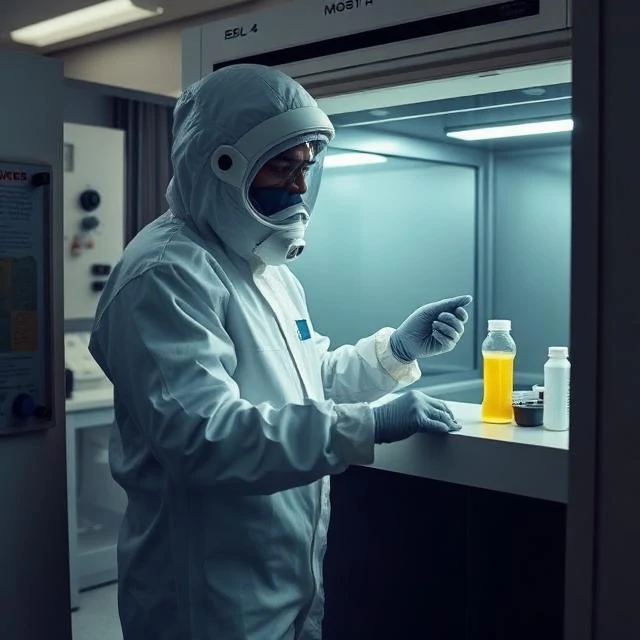
In 1975, scientists gathered at Asilomar, California, to discuss the risks of recombinant DNA. They agreed to a moratorium on certain experiments until safety guidelines were in place. That meeting established the principle of biosafety: the practices and measures that prevent harm from biological agents. The principle still guides laboratories, hospitals, and biomanufacturing facilities today.
Biosafety levels range from 1 to 4. BSL-1 handles agents that pose minimal risk, like non-pathogenic E. coli. BSL-2 handles agents that cause moderate disease, like Salmonella and HIV. BSL-3 handles agents that can cause serious disease through inhalation, like tuberculosis and SARS-CoV-2. BSL-4 handles the most dangerous agents, like Ebola and Marburg, for which there is no treatment. Each level specifies engineering controls, personal protective equipment, and work practices.
Biosafety is not just about labs. It applies to hospitals, where staff handle infectious patients. It applies to agriculture, where engineered organisms could escape. It applies to biomanufacturing, where contamination can ruin a batch and harm workers. The common thread is containment: keeping biological agents where they belong.
Biosafety failures are rare but consequential. A lab-acquired infection, a release of a modified organism, or a contamination event can have serious consequences. The rules exist because the risks are real.
Comments (3)
Leave a comment