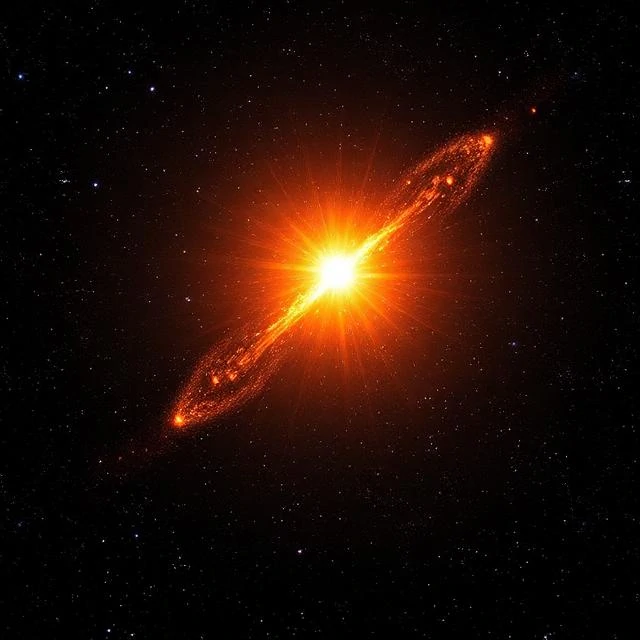
A standard candle is an object of known luminosity. If you know how bright something actually is, and you measure how bright it appears, you can calculate its distance. That is the principle behind the cosmic distance ladder. Standard candles are the rungs that let astronomers measure distances across the universe.
Different standard candles work at different distances. Cepheid variables are bright stars whose pulsation period reveals their luminosity. They work out to about 100 million light-years. Type Ia supernovae are exploding white dwarfs that reach a consistent peak brightness. They are visible billions of light-years away. The Tully-Fisher relation links a galaxy's rotation to its luminosity, providing another rung.
Each standard candle must be calibrated. A Cepheid's period-luminosity relationship is calibrated using parallax measurements of nearby Cepheids. Type Ia supernovae are calibrated using Cepheids in nearby galaxies. The chain of calibrations introduces uncertainty, which is why different methods sometimes give different answers for the Hubble constant.
Standard candles are not perfect. Dust can dim them. Their brightness can vary. But they are the best tools astronomers have for measuring the universe, and they have revealed that the expansion is accelerating, driven by dark energy.
Comments
No comments yet. Be the first to share a thought.
Leave a comment