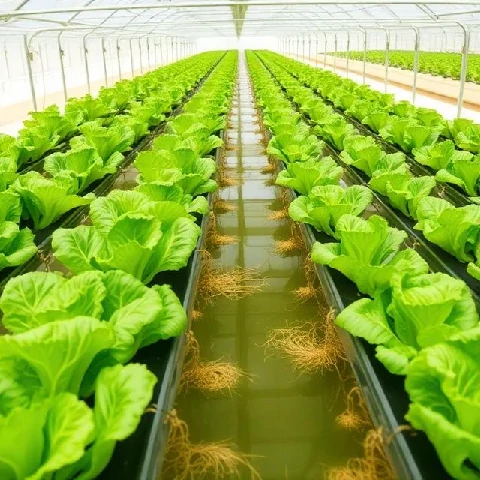
Hydroponics grows plants without soil. Roots sit in a nutrient solution, or in an inert medium like rockwool, perlite, or clay pebbles that is regularly flooded with one. The plant gets exactly what it needs, when it needs it.
The idea is not new. The Hanging Gardens of Babylon and Aztec chinampas both used water-based growing. Modern hydroponics grew out of 19th-century experiments by Wilhelm Knop and Julius von Sachs, who worked out the precise mineral solutions plants require. Commercial systems took off after World War II and now supply supermarket lettuce, tomatoes, and herbs year-round.
Common systems
- Nutrient film technique: a shallow stream of solution over bare roots
- Deep water culture: roots suspended in aerated solution
- Drip and ebb-and-flow: solution delivered to a medium on a timer
- Aeroponics: roots misted with nutrient solution
Hydroponics uses far less water than soil growing and avoids soil-borne disease. The catch is cost. Pumps, lights, and climate control add up, and a power outage can kill a crop in hours.
Comments
No comments yet. Be the first to share a thought.
Leave a comment