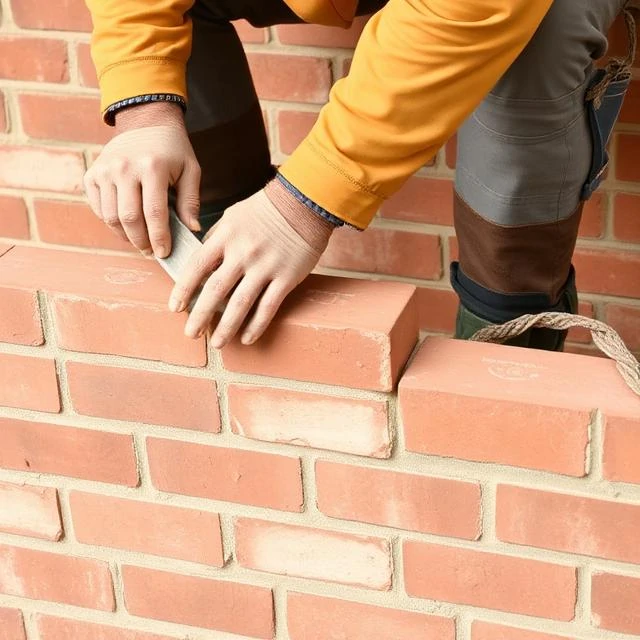
Brickwork is construction made by laying bricks in mortar. It is one of the oldest building methods and still one of the most common. A brick is a rectangular block of fired clay, strong in compression, durable, and modular. A bricklayer stacks the bricks in a pattern called a bond, spreading mortar between each course. The bond distributes loads and ties the wall together. Running bond, English bond, and Flemish bond are the most common. Each has a different look and structural behavior. In the kitchen, brickwork appears in a different form. A brick of cheese. A brick of ice cream. A brick of fudge. Each is a solid block, cut or broken for serving.
Tường gạch có thể là tường chịu lực hoặc tường ốp. Tường gạch đặc chịu được trọng lượng của chính nó và thường cả sàn và mái nhà phía trên. Nó dày, nặng và cần có móng. Tường ốp gạch là một lớp gạch duy nhất được liên kết với khung chịu lực, có một khoảng không khí và lớp chống thấm phía sau. Gạch không chịu tải trọng của tòa nhà. Nó đóng vai trò như một lớp chắn mưa. Hầu hết các tòa nhà gạch hiện đại đều sử dụng tường ốp gạch.
Brickwork has advantages. It ages well. It comes in countless colors and textures. It requires little maintenance. It provides thermal mass and fire resistance. In the kitchen, the brick of cheese ages well too. It develops flavor. It is cut and served. It is not a wall. It is an ingredient. But the logic is similar. The brick is a unit. It is stacked or cut. It is used. It is the raw material of the dish. The mason and the cook both work with bricks. One builds a wall. The other builds a meal.
Comments
No comments yet. Be the first to share a thought.
Leave a comment