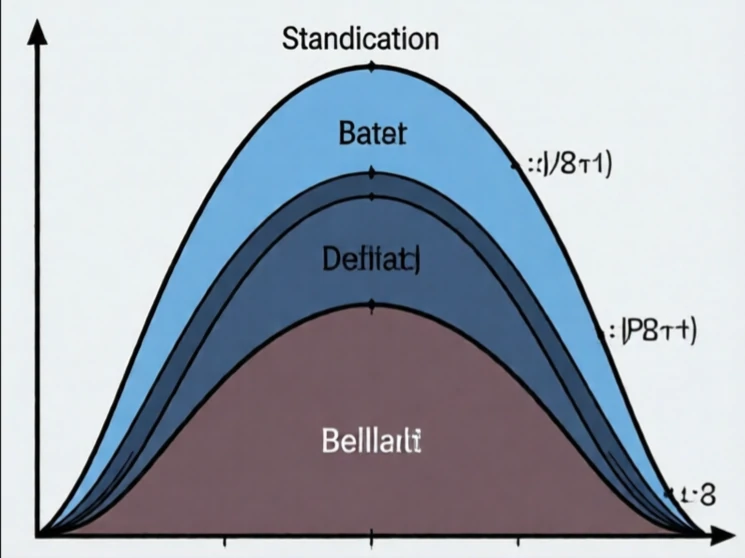
Standard deviation is a measure of how spread out the values in a data set are around the mean. It is the square root of the variance, which is the average of the squared differences from the mean. A low standard deviation means values cluster tightly around the mean; a high standard deviation means they are spread over a wider range.
In psychology and education, standard deviation is used to interpret test scores, IQ distributions, and research results. In a normal distribution, about 68% of values fall within one standard deviation of the mean, about 95% within two, and about 99.7% within three—the empirical rule.
Formula
- Population: σ = √(Σ(x − μ)² / N)
- Sample: s = √(Σ(x − x̄)² / (n − 1))
Standard deviation is expressed in the same units as the original data, which makes it more interpretable than variance.
Comments
No comments yet. Be the first to share a thought.
Leave a comment