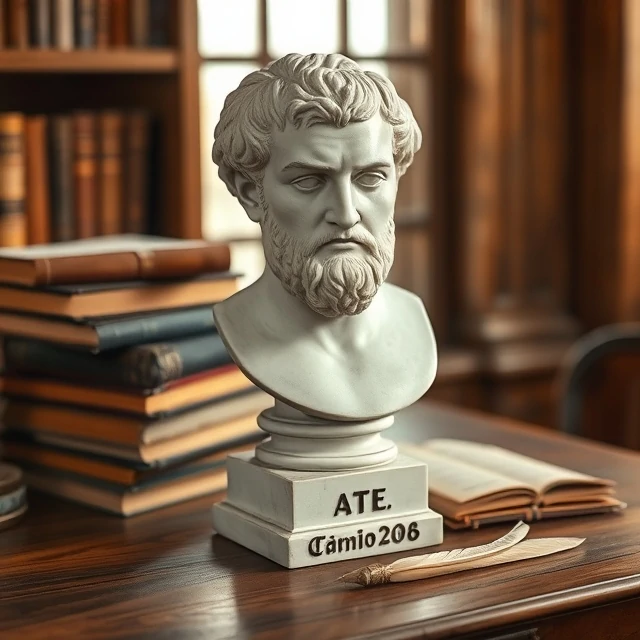
Aristotle studied under Plato for twenty years, then went his own way. Where Plato located reality in eternal Forms, Aristotle looked to the things themselves. His philosophy begins with observation. He dissected animals, catalogued plants, analyzed constitutions, and wrote on logic, ethics, politics, biology, and metaphysics. The result is a system so comprehensive that it shaped Western thought for nearly two millennia.
Aristotelianism holds that knowledge starts with experience. Forms exist, but not in a separate realm. They are the structures embedded in particular things. A horse is a horse because of the form it embodies, not because it participates in a perfect Horse beyond the world. His ethics centers on virtue, understood as a mean between extremes, cultivated through habit. His politics treats the polis as the natural setting for human flourishing. His logic, especially the syllogism, dominated Western reasoning until the 19th century.
Core features
- Empiricism. Knowledge begins with sensory experience.
- Teleology. Things have natural ends or purposes.
- Virtue ethics. Character matters more than rules or consequences.
- Four causes. Material, formal, efficient, and final.
Medieval thinkers like Thomas Aquinas fused Aristotelianism with Christian theology. Islamic scholars like Avicenna and Averroes preserved and expanded it. Its influence persists in ethics, biology, and political theory.
Comments
No comments yet. Be the first to share a thought.
Leave a comment