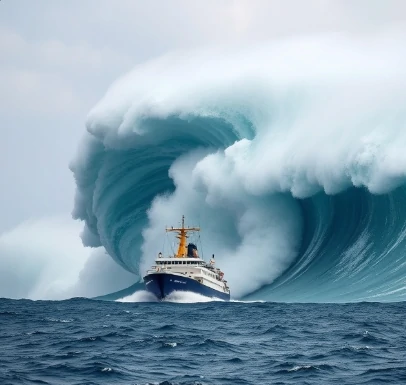
Most waves conform to predictable statistical distributions. Occasionally, however, a wave far larger than its neighbors appears without warning. These open-ocean extremes are called rogue waves. They can exceed twice the significant wave height of the surrounding sea state and have damaged or sunk ships.
Rogue waves arise from the constructive interference of wave trains, possibly amplified by currents or by nonlinear focusing mechanisms. They are more common in certain regions such as the Agulhas Current off South Africa, where waves run into opposing currents. Satellite radar and ocean buoys have confirmed that rogue waves, once dismissed as mariner folklore, are real and measurable.
Engineering design of ships and offshore structures now accounts for the possibility of rogue-wave encounters. Forecasting individual rogue waves remains impossible, but improved wave models and real-time buoy data help identify conditions in which the probability is elevated. Eyewitness accounts often describe a “wall of water” that appears suddenly from an otherwise ordinary sea.
- Unusually large wave relative to surrounding seas
- Can exceed twice the significant wave height
- Caused by interference and nonlinear effects
- Documented by buoys and satellites
Comments
No comments yet. Be the first to share a thought.
Leave a comment