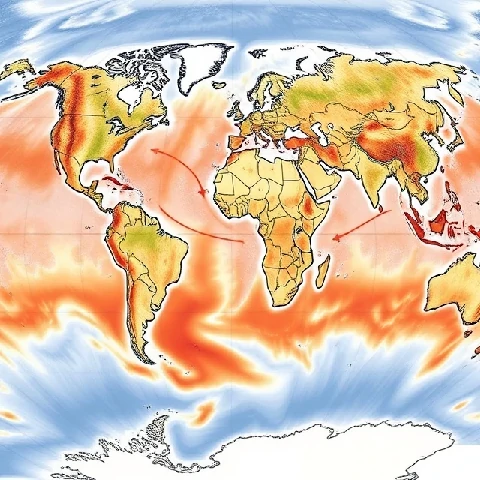
The unifying theory of modern geology holds that Earth’s outer shell is divided into rigid plates that move relative to one another. Plate tectonics explains the distribution of earthquakes, volcanoes, mountain belts, and the oceanic and continental crust itself.
Plates are created at mid-ocean ridges, move across the surface at rates of centimeters per year, and are consumed at subduction zones. Continental crust rides passively on the plates and is largely preserved. Driving forces include slab pull, ridge push, and mantle convection.
The theory emerged in the 1960s from evidence of seafloor spreading, magnetic stripes, and earthquake distribution. GPS now measures plate motions directly. Plate tectonics provides the framework for interpreting virtually all large-scale geologic processes and the long-term evolution of Earth’s surface.
- Theory of moving lithospheric plates
- Explains earthquakes, volcanoes, and mountains
- Plates created at ridges and destroyed at trenches
- Central paradigm of modern geology
Comments
No comments yet. Be the first to share a thought.
Leave a comment