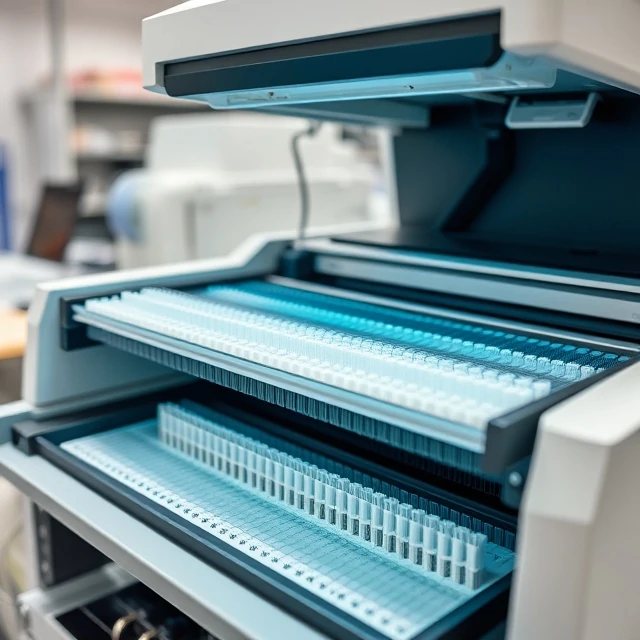
Reading DNA one fragment at a time became a bottleneck. Next-generation sequencing, or NGS, massively parallelizes the process, generating millions to billions of short reads in a single run. The technology has driven the cost of sequencing down by orders of magnitude.
Common platforms use sequencing-by-synthesis or other cyclic methods on clonally amplified templates. Applications include whole-genome, whole-exome, transcriptome, and targeted panel sequencing. Bioinformatics pipelines align the reads and call variants relative to a reference.
NGS has transformed clinical diagnostics, cancer genomics, and population studies. Challenges remain in interpreting variants of uncertain significance and managing the large data volumes. Newer long-read technologies complement short-read NGS by resolving complex regions and structural variants.
- High-throughput parallel DNA sequencing
- Generates millions of reads per run
- Enables whole-genome and targeted analyses
- Foundation of modern genomic medicine
Comments
No comments yet. Be the first to share a thought.
Leave a comment