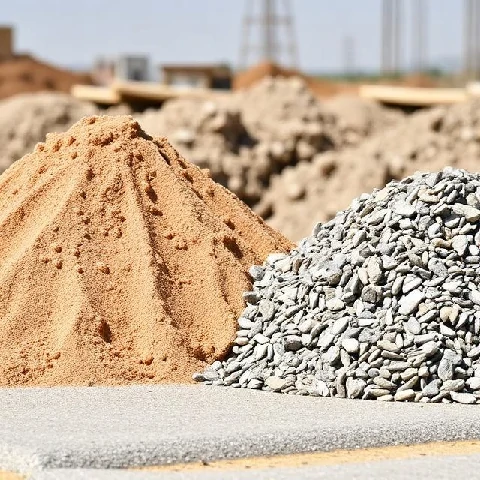
Concrete is mostly aggregate. Sand, gravel, and crushed stone make up 60 to 80 percent of the volume. The cement paste is the glue. The aggregate is the body. It gives concrete its strength, its bulk, and its dimensional stability. Without aggregate, cement paste would shrink and crack. With it, concrete becomes a durable structural material. The same principle applies in the kitchen, though the term is rarely used there. Nuts in a brownie, raisins in a scone, and chocolate chips in a cookie are aggregates of a sort, suspended in a batter matrix.
Aggregates are classified by size. Fine aggregate is sand, with particles under about 5 millimeters. Coarse aggregate is gravel or crushed stone, ranging from 5 to 40 millimeters or more. The gradation, meaning the distribution of particle sizes, affects workability and strength. A well-graded mix has particles that fill the voids between larger ones, reducing the amount of cement paste needed.
The type of aggregate matters too. Limestone, granite, and river gravel are common in concrete. In baking, the choice of inclusions shapes the texture and flavor of the final product. Chopped nuts add crunch. Dried fruit adds chew. Chocolate chunks melt into pockets. Each is an aggregate in its own right, suspended in a matrix of batter or dough. The analogy is loose, but the structural logic is similar: the matrix binds, and the aggregate gives character.
Comments
No comments yet. Be the first to share a thought.
Leave a comment