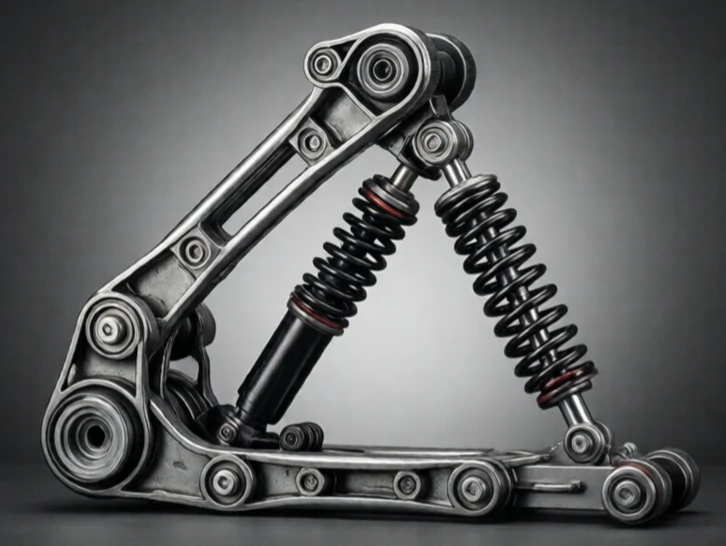
A shock absorber does not support the car. The springs do that. The shock absorber controls how the springs move. Without one, a car would bounce down the road like a pogo stick, with the tires losing contact and the body pitching wildly.
Most modern shocks are hydraulic. A piston moves through oil inside a cylinder. Small valves restrict the oil flow, converting motion into heat. That heat dissipates into the air. Gas-pressurized shocks add nitrogen to prevent the oil from foaming under hard use.
When shocks wear out
- Nose dives under braking and squats under acceleration.
- Tires cup or wear unevenly.
- Car feels floaty over dips and railroad tracks.
- Oil streaks visible on the shock body.
- Stopping distance increases, especially on wet roads.
Shocks typically last 50,000 to 100,000 miles, though rough roads shorten that. Replacing them in pairs on the same axle is standard practice. A worn shock is not just a comfort issue. It is a safety issue, because a tire that bounces has less grip when it touches down.
Comments (2)
Leave a comment