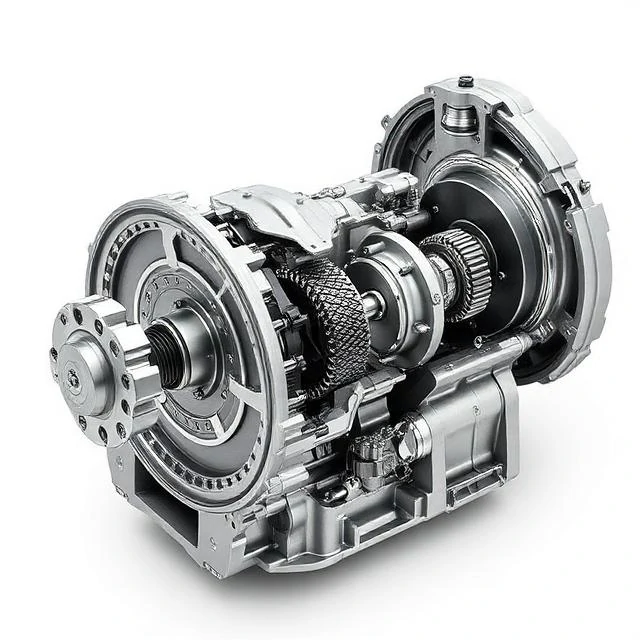
Driving a manual means working a clutch and a shifter. An automatic does that work for you. It selects the right gear ratio based on vehicle speed, engine load, and throttle position. The driver just presses the accelerator and goes.
The traditional automatic uses a torque converter, a fluid coupling that connects the engine to the transmission. It allows the car to idle in gear without stalling and multiplies torque at low speeds. Inside the transmission, planetary gearsets and clutches engage and disengage to change ratios. Hydraulic pressure, controlled by a valve body, does the shifting.
Newer designs have changed the game. Dual-clutch transmissions use two clutches, one for odd gears and one for even, to shift faster than a manual. Continuously variable transmissions use a belt and pulleys to provide an infinite range of ratios, which improves fuel economy but can feel strange to drive. Electric vehicles often have a single-speed reduction gear, because electric motors produce torque across a wide speed range.
Automatics once cost more and burned more fuel than manuals. That gap has largely closed. In the United States, manuals are now a niche product, and most new cars sold are automatics.
Comments (3)
Leave a comment