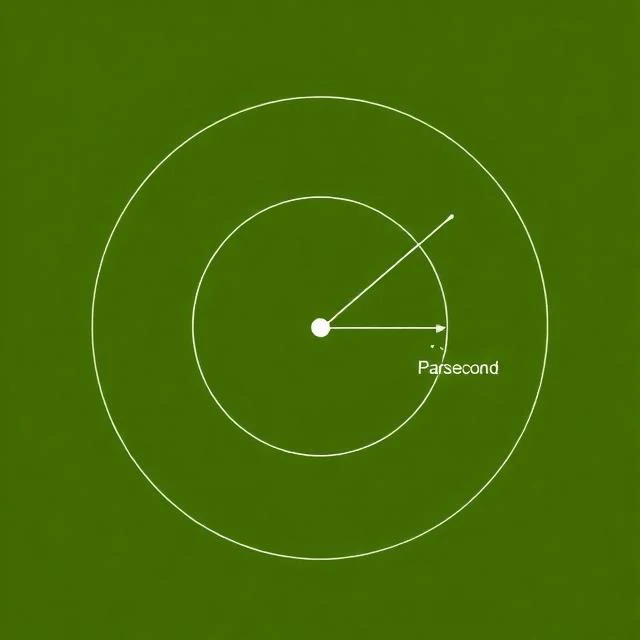
A parsec is a unit of distance equal to about 3.26 light-years, or 3.09 times 10 to the 13th power kilometers. The name comes from parallax arcsecond. It is defined as the distance at which 1 astronomical unit subtends an angle of one arcsecond. That definition ties it directly to the geometry of parallax measurement.
Astronomers prefer parsecs over light-years because the unit connects naturally to how distances are measured. If you know a star's parallax in arcseconds, its distance in parsecs is simply the inverse. A star with a parallax of 0.1 arcseconds is 10 parsecs away. A star with a parallax of 0.01 arcseconds is 100 parsecs away. The math is trivial.
The parsec is used throughout astronomy. The distance to the center of the Milky Way is about 8,000 parsecs. The Andromeda Galaxy is about 780,000 parsecs away. The nearest star, Proxima Centauri, is 1.3 parsecs away. Cosmologists use megaparsecs for galaxy clusters and gigaparsecs for the largest scales.
The unit is not intuitive for the public, which is why light-years remain more popular in popular science. But in professional astronomy, the parsec is standard.
Comments
No comments yet. Be the first to share a thought.
Leave a comment