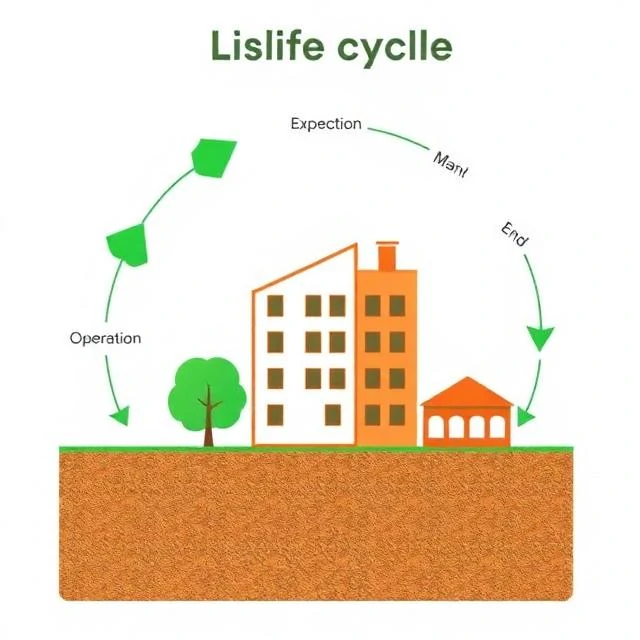
Every building has a story that starts before construction and ends long after demolition. Life Cycle Assessment, or LCA, tries to measure the environmental impact of that entire story. It counts the energy, water, and materials consumed at each stage, and the emissions and waste produced.
The stages usually include raw material extraction, manufacturing, transportation, construction, operation, maintenance, and end-of-life disposal or recycling. For most buildings, the operation phase dominates because heating and cooling consume so much energy over decades. But as buildings become more efficient, the embodied carbon in materials and construction starts to matter more.
LCA results are often expressed as a single impact score, but the details matter. A material with low carbon emissions might use scarce water. A building that saves energy in operation might rely on hard-to-recycle composites. Good LCA studies report multiple impact categories, not just one.
The method is standardized by ISO 14040 and 14044, which keeps comparisons meaningful. It is not perfect. Data gaps and assumptions can skew results. Still, it is the most rigorous tool available for understanding a building's true environmental cost.
Comments
No comments yet. Be the first to share a thought.
Leave a comment