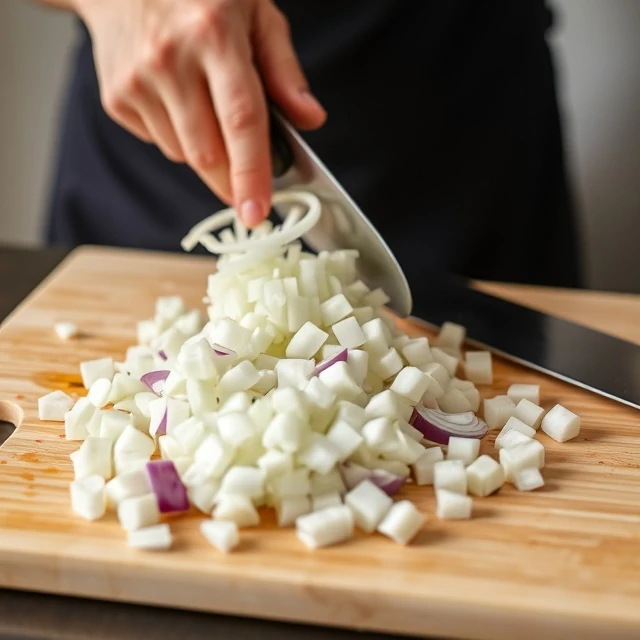
Dicing cuts food into small uniform cubes. The cubes are usually 1/4 to 1/2 inch on each side, though the size can vary. The goal is uniformity. Uniform pieces cook at the same rate. They look neat. They distribute evenly in a dish. Dicing is more precise than chopping. It requires a sharp knife and a steady hand. Onions, carrots, celery, and potatoes are commonly diced. So are tomatoes, peppers, and fruit. The dice is the building block of the dish.
Dicing has several techniques. The food is first cut into planks, then into strips, then into cubes. The knife moves in a rocking motion. The guide hand holds the food with curled fingers. The food is rotated 90 degrees between cuts. The result is a uniform cube. The technique is the same for all foods. The size is the variable. A small dice is 1/8 inch. A medium dice is 1/4 inch. A large dice is 3/4 inch. The recipe specifies the size. The cook follows the instruction.
Dicing is a fundamental skill. It is taught in culinary school. It is practiced in professional kitchens. It is used in home kitchens. A diced onion cooks evenly in a sauce. A diced carrot cooks evenly in a soup. A diced potato cooks evenly in a hash. The uniformity is the point. The dice is the discipline. The cook who dices well is a cook who cares. The knife is the tool. The board is the surface. The dice is the result. The result is the meal.
Comments
No comments yet. Be the first to share a thought.
Leave a comment