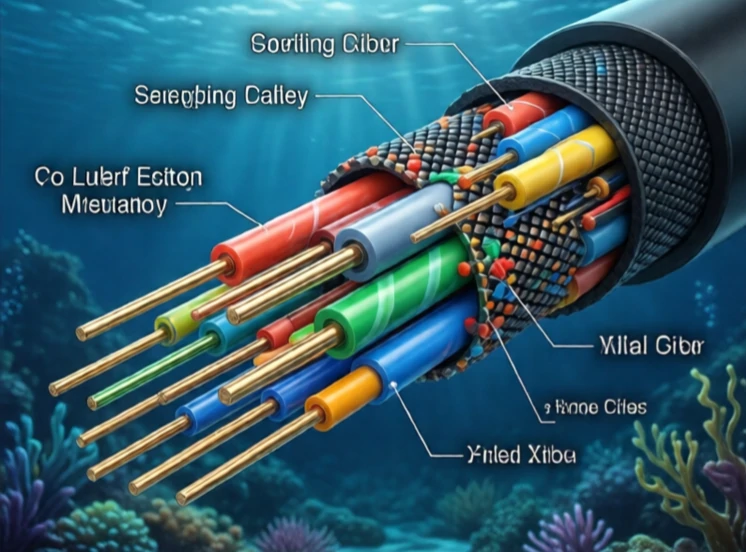
Undersea cables carry the internet between continents. Most of them are optical fiber — a flexible glass strand that transmits data as light. A fiber strand is thinner than a human hair. It carries pulses of light that encode data. Nothing else moves that much data that fast over such distances.
Fiber works by total internal reflection. Light entering the core bounces off the cladding without escaping. It travels for miles with little loss. Lasers or LEDs generate the pulses. At the other end, photodetectors convert light back into electrical signals.
Types of fiber
- Single-mode: small core, long distances, telecom
- Multi-mode: larger core, short distances, data centers
- Plastic: cheap, short runs, consumer audio
Fiber replaced copper for long-haul networks. It offers higher bandwidth, lower latency, and immunity to electromagnetic interference. But it is fragile and expensive to install. Most homes still connect via copper or coax. Fiber to the home is growing, but unevenly.
Comments
No comments yet. Be the first to share a thought.
Leave a comment