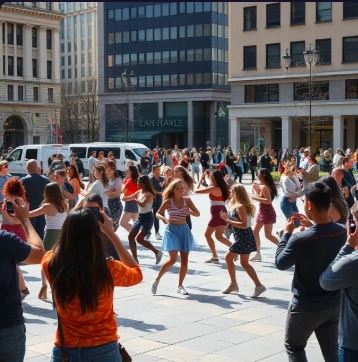
A flash mob dances in a train station. A crowd gathers around a street performer. Rumors spread about a celebrity sighting. These are examples of collective behavior — spontaneous, unstructured actions by a group of people. Unlike institutionalized behavior, it emerges quickly, follows no written rules, and often dissolves just as fast.
Sociologists study collective behavior to understand how crowds, panics, fads, and social movements form. Herbert Blumer identified types: the casual crowd, the conventional crowd, the expressive crowd, and the acting crowd. Each has different dynamics. A queue is a conventional crowd. A rioting mob is an acting crowd.
Common forms
- Crowds: temporary gatherings in shared space
- Mobs and riots: violent or disorderly crowds
- Panics: sudden fear-driven flight
- Fads and fashions: rapidly spreading interests
- Rumors: unverified information circulating
Digital technology has changed collective behavior. Online petitions, viral challenges, and coordinated hashtags can mobilize thousands without physical proximity.
Comments
No comments yet. Be the first to share a thought.
Leave a comment