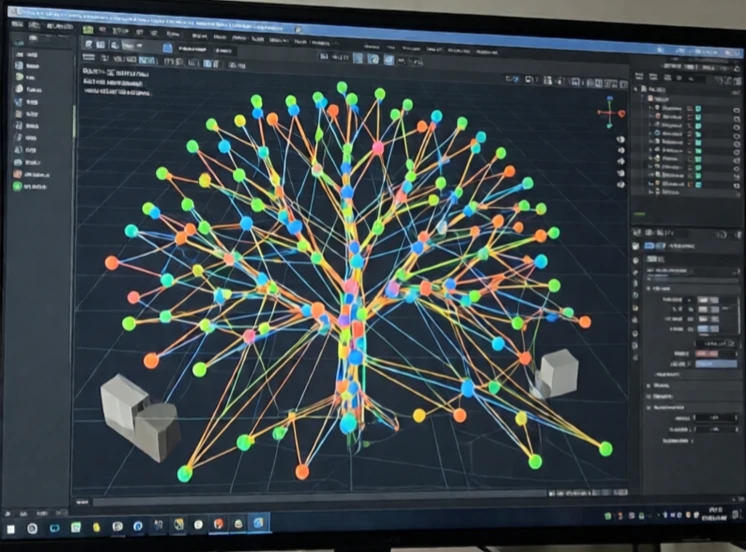
Motion planning determines how a robot moves from one configuration to another without hitting anything. It considers the robot's shape, the obstacles around it, and the constraints on its joints. The output is a path or trajectory that the controller can execute.
The problem is hard. The robot might have six or more joints. The configuration space has as many dimensions. Obstacles in the workspace become forbidden regions in configuration space. Finding a path through that space is computationally expensive. Sampling-based planners like RRT and PRM build a graph of feasible configurations and search it. Optimization-based planners minimize a cost function while respecting constraints.
Motion planning considerations
- Collision avoidance: stay clear of obstacles.
- Joint limits: stay within mechanical range.
- Velocity and acceleration limits: stay within dynamic capability.
- Smoothness: avoid jerky motion.
- Uncertainty: account for sensor and model error.
A plan that works in simulation may fail on the real robot because the model is imperfect. The real world has friction, flex, and sensor noise. That is why motion planning often runs in a loop with execution. The robot plans a path, starts moving, senses a deviation, and replans. Replanning must be fast enough to keep up with the robot's motion. For a drone flying through a forest, that means milliseconds. For a warehouse robot, it can be slower. Motion planning is the bridge between a goal and a movement. Without it, the robot does not know how to get there.
Comments
No comments yet. Be the first to share a thought.
Leave a comment