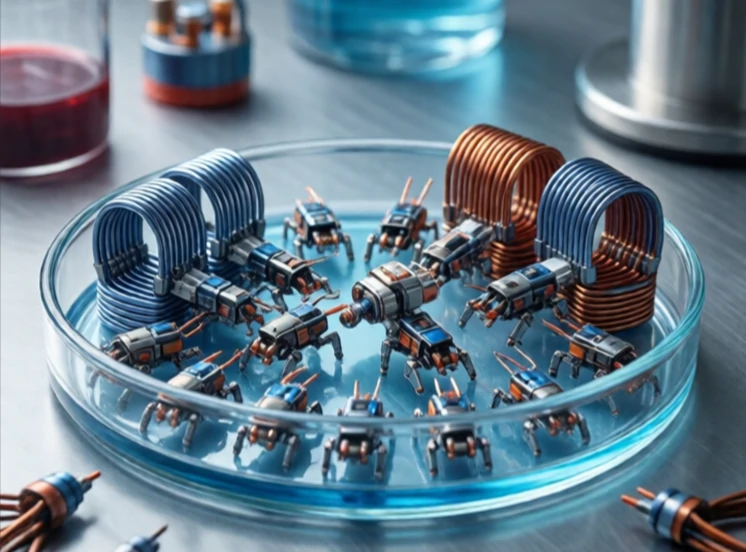
A microrobot operates at the millimeter scale. It is small enough to fit inside a human blood vessel, crawl through a pipe, or swarm with thousands of others. The challenges are different from those of larger robots. Physics changes at small scales. Gravity matters less. Surface tension and friction dominate.
Researchers build microrobots using MEMS fabrication, soft lithography, and magnetic materials. Some are powered by external magnetic fields. Others use chemical reactions or acoustic waves. A magnetic microrobot can be steered through a fluid by a coil system outside the body. A catalytic microrobot propels itself by converting hydrogen peroxide into oxygen bubbles.
Microrobot applications
- Targeted drug delivery inside the body.
- Microsurgery and cell manipulation.
- Pipe inspection and repair.
- Environmental sensing in water.
- Swarm research and collective behavior.
The obstacles are power, control, and imaging. Batteries do not scale down. A microrobot cannot carry its own power source, so it relies on external fields or chemical fuel. Control is imprecise because Brownian motion jostles the robot. Imaging inside the body requires MRI or ultrasound, which limits real-time feedback. Microrobots are not yet in clinical use, but they have moved from science fiction to laboratory demonstrations. A robot the size of a grain of rice that swims through blood and delivers a drug to a tumor is not here yet. It is getting closer.
Comments
No comments yet. Be the first to share a thought.
Leave a comment