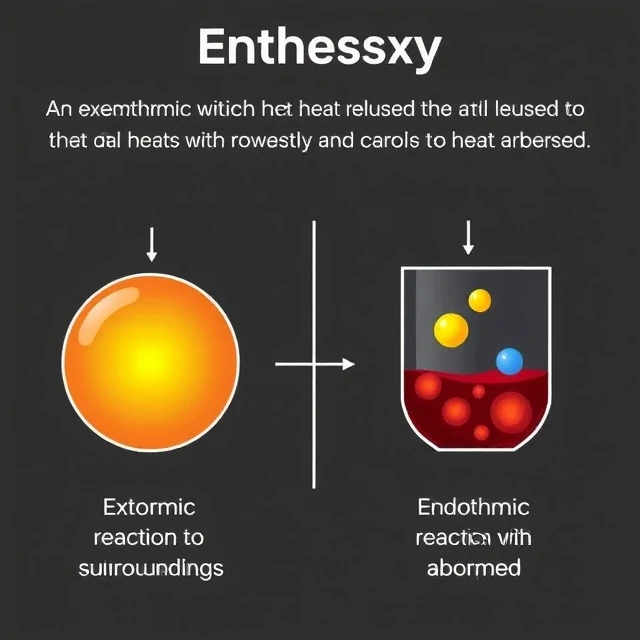
Enthalpy is the total heat content of a system at constant pressure. It is a thermodynamic quantity, denoted by H, and it equals the internal energy of the system plus the product of pressure and volume. Enthalpy is useful because most chemical reactions happen at constant pressure, open to the atmosphere. The heat absorbed or released in such a reaction is the change in enthalpy, written as ΔH. A negative ΔH means the reaction releases heat, and it is called exothermic. A positive ΔH means the reaction absorbs heat, and it is called endothermic.
Enthalpy is a state function, which means it depends only on the current state of the system, not on how it got there. That makes it convenient for calculating energy changes. Hess's law says that the total enthalpy change for a reaction is the sum of the enthalpy changes for each step, regardless of the path. That allows chemists to calculate energy changes for reactions that are difficult to measure directly. Enthalpy is used in chemistry, engineering, and meteorology. In weather, the enthalpy of moist air matters for understanding storms and convection.
Enthalpy facts
- Definition. H = U + PV.
- State function. Depends only on current state.
- Exothermic. Releases heat, negative ΔH.
- Endothermic. Absorbs heat, positive ΔH.
- Hess's law. Total ΔH is sum of steps.
Enthalpy is not the same as heat. Heat is a transfer of energy. Enthalpy is a property of the system.
Comments
No comments yet. Be the first to share a thought.
Leave a comment