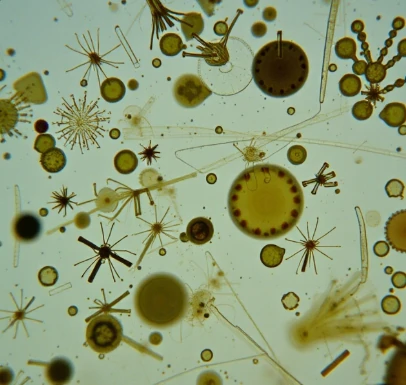
Any organism that drifts with ocean currents and cannot swim against them is considered plankton. The category spans bacteria, archaea, phytoplankton, zooplankton, and the larval stages of many larger animals. Size classes range from viruses to jellyfish several meters across.
Plankton form the foundation of marine food webs and drive major biogeochemical cycles. Phytoplankton produce organic matter; zooplankton graze it and transfer energy to fish and other consumers. Daily vertical migrations of zooplankton constitute one of the largest animal movements on the planet by biomass.
Sampling plankton traditionally uses nets and bottles; optical and acoustic sensors and environmental DNA methods are expanding observational capacity. Plankton communities respond quickly to changes in temperature, nutrients, and predation, making them sensitive indicators of environmental change. Their distributions and seasonal cycles are being altered by ocean warming and acidification in many regions.
A liter of surface seawater can contain millions of individual planktonic organisms.
Comments
No comments yet. Be the first to share a thought.
Leave a comment