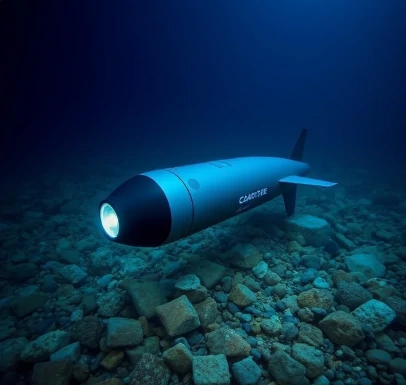
An Autonomous Underwater Vehicle, or AUV, explores the ocean without a tether and without a pilot. It carries its own power, navigation, and sensors. It dives, surveys, and returns to a preprogrammed point. Some AUVs operate for hours. Others, like gliders, drift for months on small changes in buoyancy.
The ocean is hostile to robotics. Radio waves do not travel well underwater, so GPS does not work below the surface. AUVs navigate by dead reckoning, inertial sensors, and acoustic positioning. They communicate with surface ships only when they surface or via acoustic modems. Corrosion, pressure, and biofouling shorten equipment life.
What AUVs do
- Map the seafloor with sonar.
- Survey oil and gas pipelines.
- Search for wreckage and downed aircraft.
- Measure water temperature, salinity, and currents.
- Track marine life and monitor fisheries.
AUVs have explored under ice shelves in Antarctica, descended to the wreck of the Titanic, and helped locate the black boxes of crashed airliners. They are cheaper and safer than manned submersibles for many tasks. The main limitation is battery life and decision-making. An AUV cannot ask for help when something goes wrong. It has to be programmed to handle failures on its own. That makes reliability engineering as important as the sensors and software.
Comments
No comments yet. Be the first to share a thought.
Leave a comment