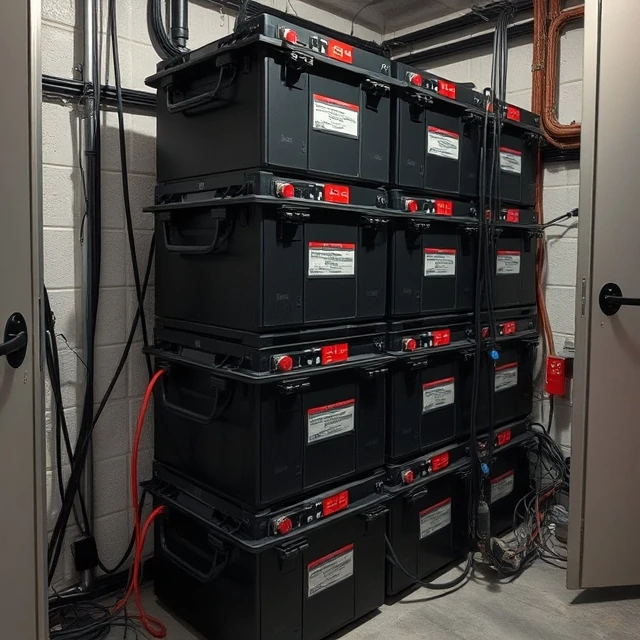
Almost every gasoline car has one under the hood. The lead-acid battery starts the engine, powers the lights, and stabilizes voltage. It was invented in 1859 by Gaston Planté and remains the oldest rechargeable battery in wide use. The chemistry is simple: lead plates in sulfuric acid.
Lead-acid batteries are heavy and have low energy density. A typical car battery weighs around 20 kilograms and stores less than a kilowatt-hour. But they are cheap, reliable, and can deliver a large burst of current, which is exactly what a starter motor needs. They also tolerate a wide range of temperatures.
Their role is expanding beyond cars. Utilities use large lead-acid banks for backup power. Off-grid homes rely on them for solar storage, though lithium-ion is replacing them in many new installations. Recycling rates are high, above 95 percent in many countries, which keeps lead out of landfills.
Key features
- Lead and sulfuric acid chemistry
- Low cost per unit
- High surge current
- Recyclable
- Heavy and bulky
Comments
No comments yet. Be the first to share a thought.
Leave a comment