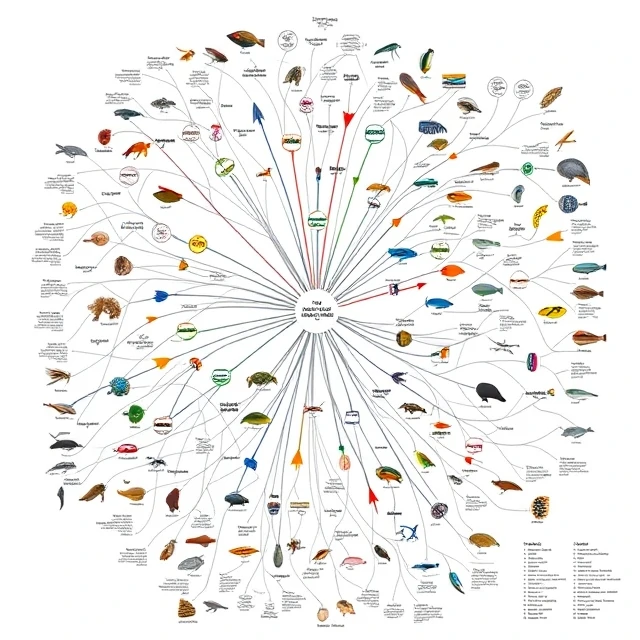
A food web maps all the feeding relationships in an ecosystem. It is a network of interconnected food chains, showing which organisms eat which, and how energy moves through the system. A food web for a pond might include algae, water fleas, small fish, frogs, herons, and bacteria. Arrows point from the organism being eaten to the organism that eats it. The result looks like a tangled diagram, which is the point. Real ecosystems are tangled.
Food webs reveal indirect effects. Remove a top predator and herbivore populations may explode, overgrazing the plants that other species depend on. Add an invasive species and it may outcompete native species for food, shifting the entire web. Ecologists study food webs to understand resilience and vulnerability. A web with many connections is more stable than one with few. If one prey species declines, predators can switch to another. In a simple web, there is no backup.
Key features
- Multiple interconnected food chains.
- Arrows showing energy flow.
- Trophic levels from producers to top predators.
- Indirect effects that ripple through the system.
Food webs are models, not photographs. They simplify reality to make patterns visible. The best ones are built from years of field observation.
Comments
No comments yet. Be the first to share a thought.
Leave a comment