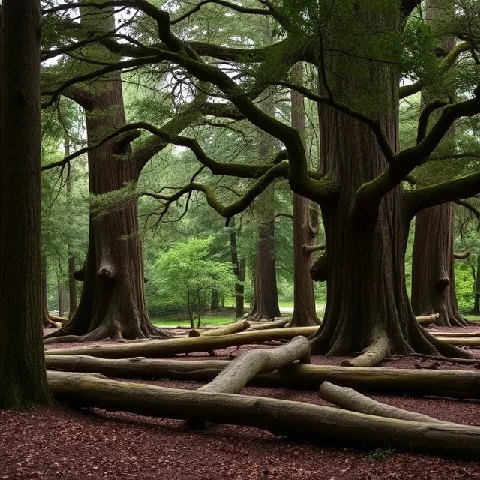
Ecologists once described succession as a series of stages ending in a stable climax community. A bare field gives way to grasses, then shrubs, then pioneer trees, and finally a mature forest that persists until disturbed. The idea was central to the work of Frederic Clements in the early 20th century. He argued that each region had a single climax determined by climate, and that succession moved toward it like an organism developing toward adulthood.
That view has largely been replaced. Modern ecology sees communities as dynamic and disturbance-driven. A forest may never reach a stable endpoint. Fires, storms, insects, and human land use reset succession repeatedly. Henry Gleason argued in the 1920s that communities are loose assemblages of species responding individually to conditions, not integrated superorganisms. His view gained support over time. Today, ecologists speak of late-successional or old-growth communities rather than a single climax.
Succession stages
- Pioneer species: first to colonize bare ground.
- Intermediate species: shrubs and fast-growing trees.
- Late-successional: slow-growing, shade-tolerant trees.
- Disturbance: fire, storm, or human use resets the sequence.
Old-growth forests still matter. They hold carbon, harbor species found nowhere else, and take centuries to develop. Protecting them is not about reaching a climax. It is about letting natural processes continue.
Comments
No comments yet. Be the first to share a thought.
Leave a comment