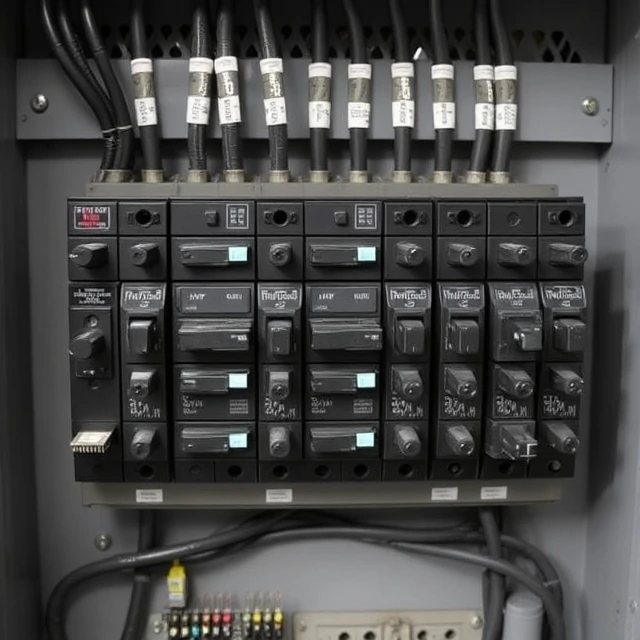
A circuit breaker automatically interrupts current to prevent overload. It is a safety device. When too much current flows through a circuit, the breaker trips and opens the circuit. That stops the flow of electricity and prevents the wires from overheating, which could cause a fire. The breaker can be reset manually after the problem is fixed. It is not a fuse. A fuse melts and must be replaced. A breaker can be reused.
Circuit breakers come in several types. A standard breaker protects against overload and short circuits. A ground fault circuit interrupter, or GFCI, protects against ground faults, which can cause electrocution. It is required in bathrooms, kitchens, and outdoors. An arc fault circuit interrupter, or AFCI, protects against arc faults, which can cause fires. It is required in bedrooms and living areas. A main breaker controls the entire panel. A subpanel has its own breakers for a specific area.
Circuit breakers are installed in a panel, also called a breaker box or load center. The panel distributes power from the utility to the circuits in the building. Each circuit has its own breaker. The breaker size is matched to the wire size. A 15-amp breaker protects 14-gauge wire. A 20-amp breaker protects 12-gauge wire. If the breaker is too large, the wire can overheat before the breaker trips. That is a fire hazard. The breaker must be sized to the wire, not the load. The electrical code specifies the rules.
Comments (3)
Leave a comment