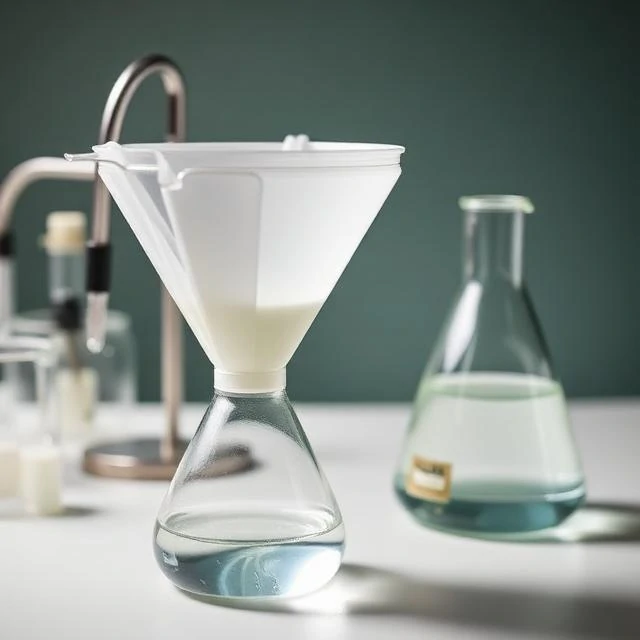
Making coffee involves filtration. Hot water passes through ground coffee, and a paper filter traps the grounds while the liquid flows through. Filtration separates solids from liquids using a porous barrier. The barrier, called the filter medium, allows the liquid to pass through but blocks the solid particles. The liquid that passes through is the filtrate. The solid remaining on the filter is the residue.
Filtration is used in many contexts. In the laboratory, filter paper and funnels separate precipitates from solutions. In industry, filter presses dewater slurries, baghouses capture dust from exhaust gases, and membrane filters purify water and pharmaceuticals. In the home, vacuum cleaners, air purifiers, and water filters all use filtration. In the body, the kidneys filter blood, removing waste products and excess water to form urine.
The choice of filter medium depends on the application. Particle size, flow rate, chemical compatibility, and cost all matter. Filter paper is cheap and disposable. Membranes have precise pore sizes for sterile filtration. Sand and gravel are used in water treatment. Activated carbon adsorbs impurities in addition to filtering them. Each medium has its strengths.
Filtration is not the same as distillation or chromatography. It separates based on particle size, not boiling point or solubility. It is a physical separation, not a chemical reaction. The components retain their identity. It is one of the simplest and most widely used separation techniques.
Comments
No comments yet. Be the first to share a thought.
Leave a comment