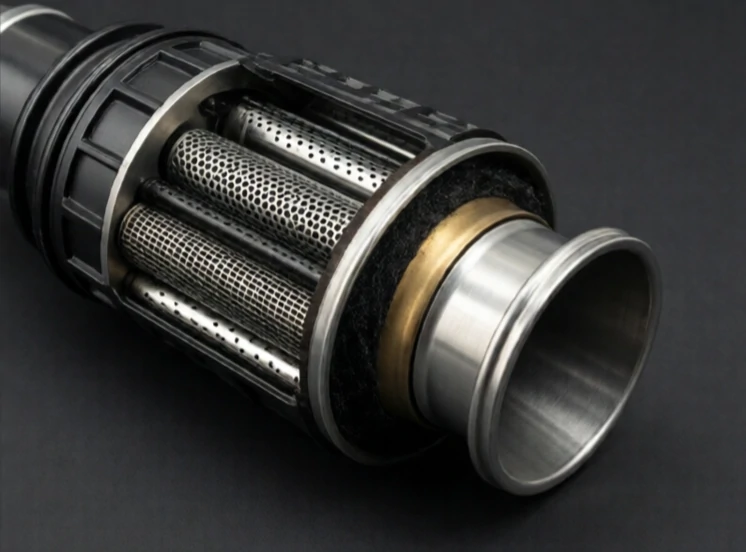
A muffler does not eliminate engine noise. It shapes it. Exhaust gases leave the engine in sharp pulses that produce a loud bark. The muffler routes those pulses through chambers, perforated tubes, and sound-absorbing material to smooth them into a tolerable hum.
Most mufflers use a combination of reflection and absorption. Reflective designs bounce sound waves back on themselves to cancel out specific frequencies. Absorptive designs pack fiberglass or steel wool around a perforated pipe to soak up high-frequency noise. Straight-through mufflers flow well but quiet less. Chambered mufflers quiet more but restrict flow.
Materials and failure
- Aluminized steel: common, affordable, rusts eventually.
- Stainless steel: longer life, higher cost.
- Condensation inside the muffler causes rust from the inside out.
- Short trips accelerate corrosion because the muffler never fully dries.
A rusted-out muffler roars. A clogged one strangles performance. Neither is subtle, and both are easy for a mechanic to spot. In many jurisdictions, a noisy exhaust is a fix-it ticket waiting to happen.
Comments
No comments yet. Be the first to share a thought.
Leave a comment