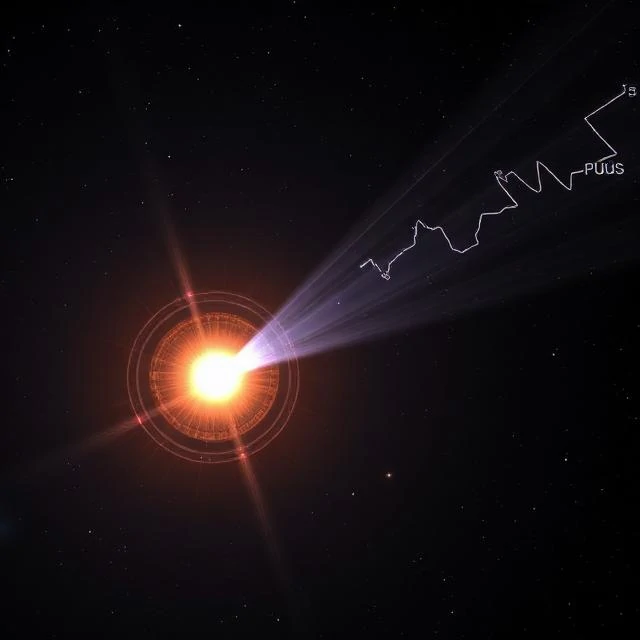
In 1967, Jocelyn Bell Burnell noticed a radio signal that pulsed every 1.337 seconds. It was so regular that the team briefly called it LGM-1, for little green men. It turned out to be a pulsar, a rapidly rotating neutron star that emits beams of radiation from its magnetic poles. As the star spins, the beams sweep past Earth like a lighthouse, producing a pulse with each rotation.
Pulsars are incredibly stable clocks. Some rotate hundreds of times per second, with periods accurate to better than a millionth of a second. That precision makes them useful for testing general relativity, detecting gravitational waves, and even navigating spacecraft. The Voyager probes carry a pulsar map on their golden records, showing Earth's location in the galaxy.
Not all pulsars are the same. Most pulse in radio waves, but some emit X-rays or gamma rays. Magnetars are a type of pulsar with extremely strong magnetic fields. Millisecond pulsars have been spun up by accreting matter from a companion star. They are the most precise clocks in the universe.
The discovery of pulsars won the Nobel Prize in 1974. Bell Burnell, who made the initial observation, was not included, a decision that remains controversial.
Comments
No comments yet. Be the first to share a thought.
Leave a comment