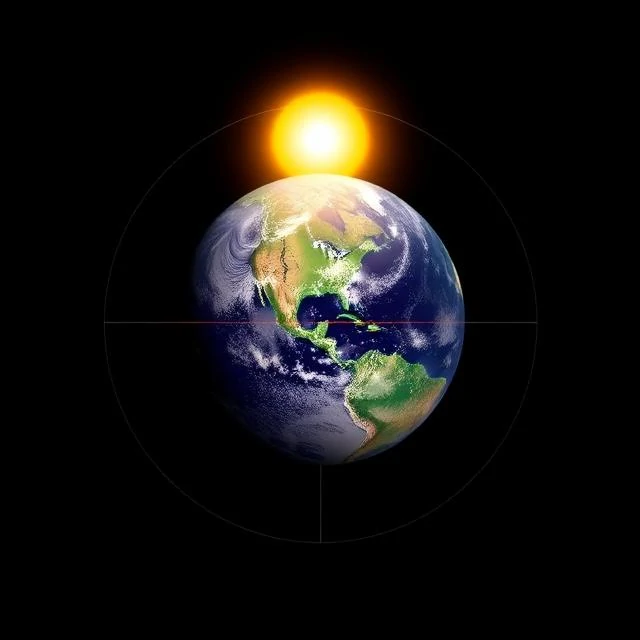
Twice a year, day and night are roughly equal everywhere on Earth. Those moments are the equinoxes. The word comes from Latin: aequus meaning equal and nox meaning night. They occur around March 20 and September 22 each year.
At an equinox, the Sun sits directly above Earth's equator. Earth's axis is tilted neither toward nor away from the Sun. The terminator, the line between day and night, runs from pole to pole. Everyone gets about 12 hours of daylight and 12 hours of darkness.
The equinoxes are not just astronomical events. They mark the changing seasons. In the northern hemisphere, the March equinox signals spring, and the September equinox signals autumn. In the southern hemisphere, it is the reverse. Many cultures celebrate these transitions with festivals and holidays.
The equinoxes also define the coordinate system. The vernal equinox, where the Sun crosses the celestial equator going north, is the zero point for right ascension. The autumnal equinox is where it crosses going south. Those two points anchor the celestial sphere.
Comments
No comments yet. Be the first to share a thought.
Leave a comment