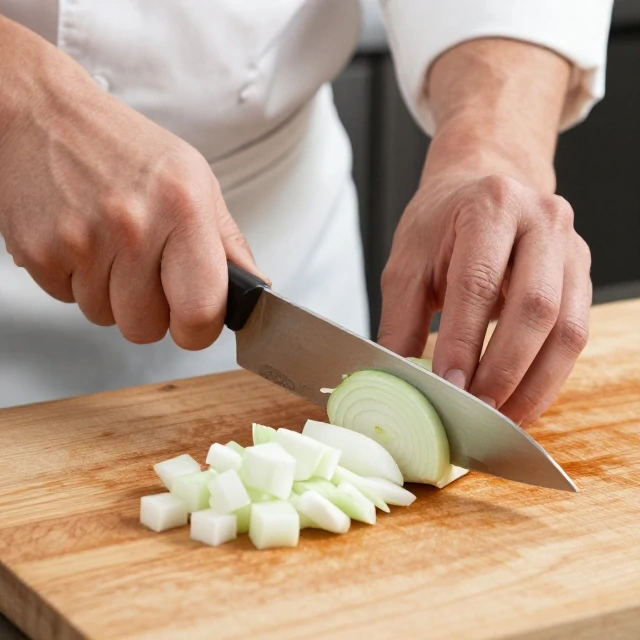
Dicing cuts food into small, uniform cubes. The cubes are usually 1/4 to 1/2 inch. Uniformity is the goal. Even pieces cook evenly. They look neat. They mix well with other ingredients. Dicing is a basic knife skill. It takes practice. It is worth learning.
The technique starts with a flat surface. Cut the food in half. Place the flat side down. Cut planks. Cut the planks into strips. Cut the strips into cubes. The size depends on the recipe. A small dice is 1/4 inch. A medium dice is 1/2 inch. A large dice is 3/4 inch. The knife should be sharp. A dull knife slips. It bruises the food. It is dangerous. A sharp knife cuts cleanly. It is safer and faster.
How to dice an onion
- Cut the onion in half through the root.
- Peel the skin and leave the root intact.
- Make horizontal cuts toward the root.
- Make vertical cuts toward the root.
- Slice across to create cubes.
Dicing is therapeutic. It is repetitive. It is rhythmic. The knife goes up and down. The pile of cubes grows. The onion releases its sharp scent. The carrots add color. The celery adds crunch. The mirepoix is ready. It is the start of a soup. A stew. A sauce. Dicing is not glamorous. It is not the star of the dish. But it is the foundation. A well-diced vegetable cooks evenly. A poorly diced one does not. The small pieces burn. The large pieces stay raw. The dish suffers. Dicing is a skill. It takes time. But it pays off. Every good cook knows how to dice. It is the alphabet of the kitchen.
Comments
No comments yet. Be the first to share a thought.
Leave a comment