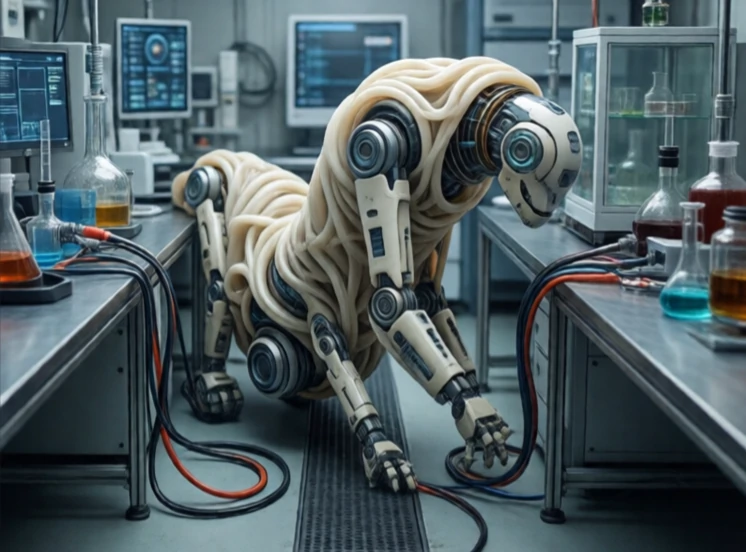
Soft robotics builds robots from flexible, compliant materials. Silicone, rubber, fabric, and gels replace metal and rigid plastic. The robots bend, stretch, and squeeze. They are safer around humans and better at handling fragile objects.
The field grew out of research in the 2000s. Octopus-inspired arms, pneumatic grippers, and wearable exosuits are common prototypes. A soft gripper can pick up a raw egg, a strawberry, or a heavy wrench without changing settings. A soft robot can squeeze through a narrow gap, then inflate to resume its shape. The compliance is built into the material, not controlled by software.
Soft robotics advantages
- Safe for human interaction.
- Handles fragile and irregular objects.
- Adapts to unknown environments.
- Lightweight and cheap to fabricate.
- Naturally compliant.
The challenges are control, sensing, and power. Soft materials deform unpredictably. Modeling their behavior is hard. Sensors that stretch with the material are still limited. Actuation often relies on pneumatics, which requires compressors and valves. Soft robots are not precise. They cannot hold a position against a load without stiffening. That limits them to tasks where compliance is an advantage: gripping, locomotion in cluttered spaces, and wearable assistance. Soft robotics is not replacing rigid robots. It is expanding what robots can do. A soft gripper on a rigid arm combines precision with adaptability. A soft exosuit helps a stroke patient walk without the bulk of a rigid frame. The field is young, but the materials are cheap and the potential is broad.
Comments
No comments yet. Be the first to share a thought.
Leave a comment