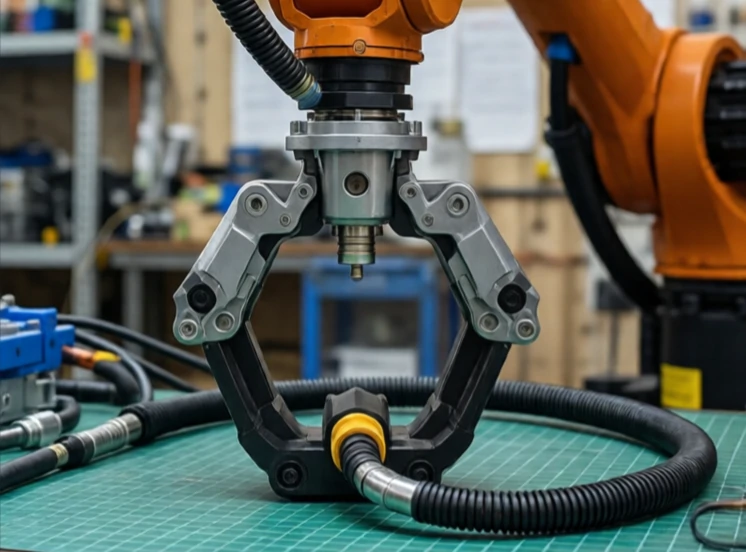
A pneumatic actuator uses compressed air to produce motion. Push air into a cylinder and the piston moves. Release the air and a spring returns it. Pneumatic actuators are fast, cheap, and simple. They are also hard to control precisely because air compresses.
Factories use pneumatics everywhere. A pneumatic cylinder opens and closes a gripper. A rotary actuator turns a valve. A vacuum ejector picks up a box with suction. The air comes from a compressor and travels through lines and valves. The system is robust and forgiving. Overload it and the air just escapes. No burned motors, no broken gears.
Pneumatic actuator characteristics
- Fast response: air moves quickly.
- High force: large cylinders produce tons of force.
- Clean: no oil leaks like hydraulics.
- Compressible: air springs, hard to position precisely.
- Inefficient: compressors waste energy as heat.
The compressibility of air is the main limitation. A pneumatic cylinder cannot hold a position under varying load without a servo valve and feedback. That makes pneumatics better for on/off tasks than for precise positioning. A pneumatic gripper either open or closed. A pneumatic press either up or down. For those tasks, pneumatics are ideal. They are cheap, durable, and easy to maintain. For tasks that need smooth motion and precise force, electric actuators are usually better. Pneumatics still dominate in packaging, assembly, and material handling because they are simple and reliable. Sometimes the best control is no control at all.
Comments
No comments yet. Be the first to share a thought.
Leave a comment