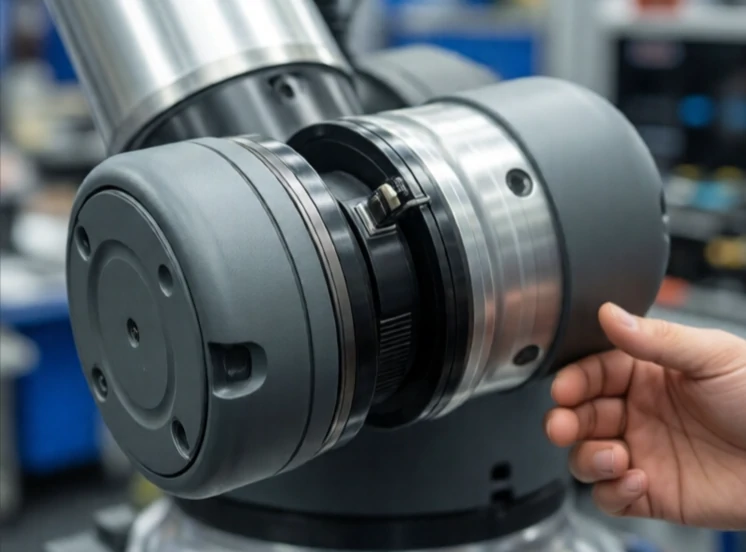
A collaborative robot, or cobot, is designed to work safely alongside humans. Traditional industrial robots operate behind fences because they are fast and powerful enough to injure anyone in their path. Cobots are smaller, lighter, and equipped with sensors that stop movement when a person gets too close.
The first cobot, the Universal Robots UR5, arrived in 2008. It weighed 18 kilograms and could be mounted on a workbench. Since then, every major robot maker has entered the category. Cobots are popular in small and mid-size manufacturers that cannot justify the cost and space of a fenced robot cell.
How cobots stay safe
- Power and force limiting: motors stall when they meet resistance.
- Safety-rated monitored stop: robot pauses when a person enters the workspace.
- Speed and separation monitoring: robot slows as a person approaches.
- Hand guiding: operator moves the robot by hand to teach a path.
- Rounded joints and pinch-point design.
Cobots are not always safe by default. A sharp tool on the end of a cobot arm can still cut. A heavy payload moving at speed can still bruise. Risk assessments are required, and safety standards like ISO/TS 15066 provide guidance. The appeal is flexibility. A cobot can be moved to a new task in an afternoon. It can hand a part to a human or take a finished piece away. It is a colleague, not a replacement, and that framing has made it easier for workers to accept.
Comments
No comments yet. Be the first to share a thought.
Leave a comment