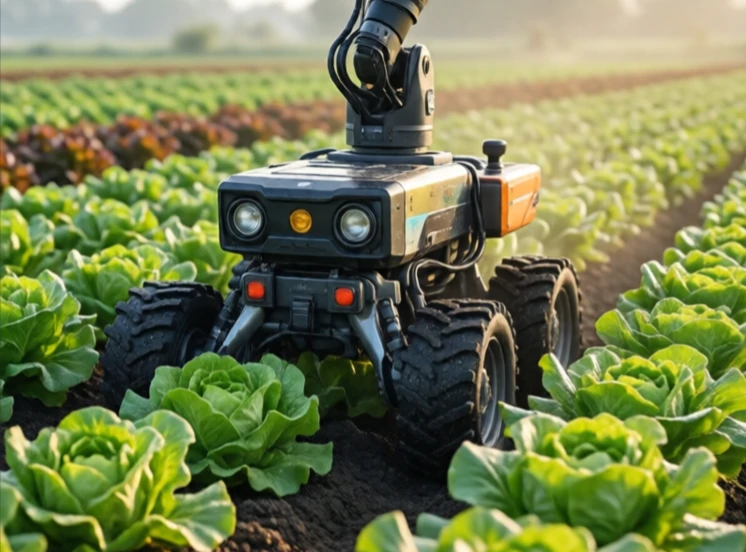
Agricultural robots handle farming tasks that are repetitive, labor-intensive, or need to happen around the clock. They plant seeds, pull weeds, spray pesticides precisely, and harvest fruit. The driver is not always a person. Sometimes it is a GPS-guided tractor. Sometimes it is a small ground robot crawling between rows.
The driver for adoption is labor shortage. Farms struggle to find workers for planting, thinning, and harvesting. Robots fill the gap, though they are not cheap. A robotic milking system can cost six figures, but it lets a dairy farmer milk more cows with less labor. Autonomous tractors and combines reduce operator fatigue and improve accuracy on large fields.
What agricultural robots do
- Seed planting with centimeter-level GPS accuracy.
- Weeding with cameras and precision sprayers.
- Harvesting delicate fruits like strawberries and apples.
- Monitoring crop health with drones and ground sensors.
- Milking cows and feeding livestock automatically.
The hardest problems are unstructured environments. A factory robot works in a fixed cell. A farm robot works in mud, dust, wind, and changing light. Crops vary in size and shape. Weeds look like crops. That is why agricultural robotics advances more slowly than warehouse automation. But the potential is enormous: less chemical use, higher yields, and food production that does not depend on an endless supply of seasonal labor.
Comments
No comments yet. Be the first to share a thought.
Leave a comment