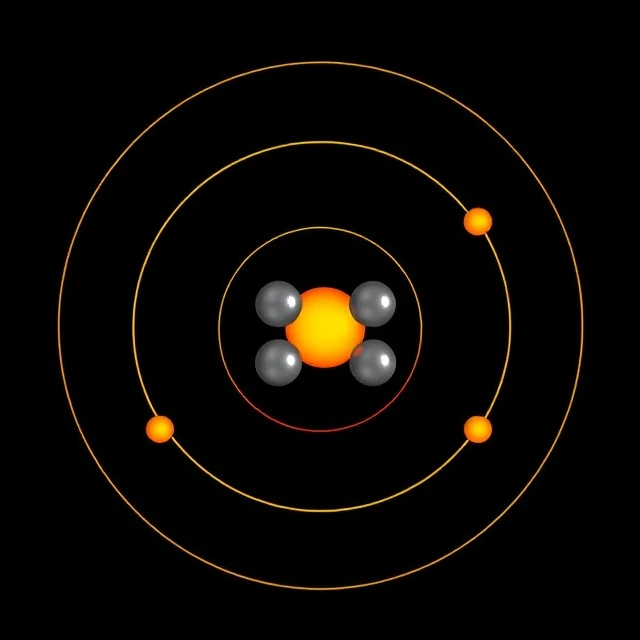
A neutron is a subatomic particle with no electric charge. It sits in the nucleus of an atom, alongside protons. Neutrons are slightly heavier than protons, about 1.675 × 10⁻²⁷ kilograms. They are made of three quarks: two down quarks and one up quark. The neutron was discovered by James Chadwick in 1932, a discovery that earned him the Nobel Prize in Physics in 1935. Neutrons are essential to the stability of most nuclei. Without them, protons would repel each other and the nucleus would fly apart.
Neutrons are stable inside most nuclei, but a free neutron decays in about 15 minutes. It undergoes beta decay, turning into a proton, an electron, and an antineutrino. That process is called beta decay, and it is one of the ways radioactivity occurs. Neutrons are also used in nuclear reactors. They initiate and sustain the chain reaction in fission. In medicine, neutron beams are used in radiation therapy for certain cancers. In materials science, neutron scattering reveals the structure of crystals and molecules. Neutrons are also used in neutron bombs, a type of nuclear weapon that produces a lethal burst of neutron radiation with relatively little blast.
Neutron facts
- Charge. Neutral, no electric charge.
- Mass. Slightly heavier than a proton.
- Discovery. James Chadwick, 1932.
- Quarks. Two down, one up.
- Decay. Free neutron decays in about 15 minutes.
A neutron is not the same as a neutrino. A neutrino is a nearly massless lepton. A neutron is a heavy baryon made of quarks.
Comments
No comments yet. Be the first to share a thought.
Leave a comment