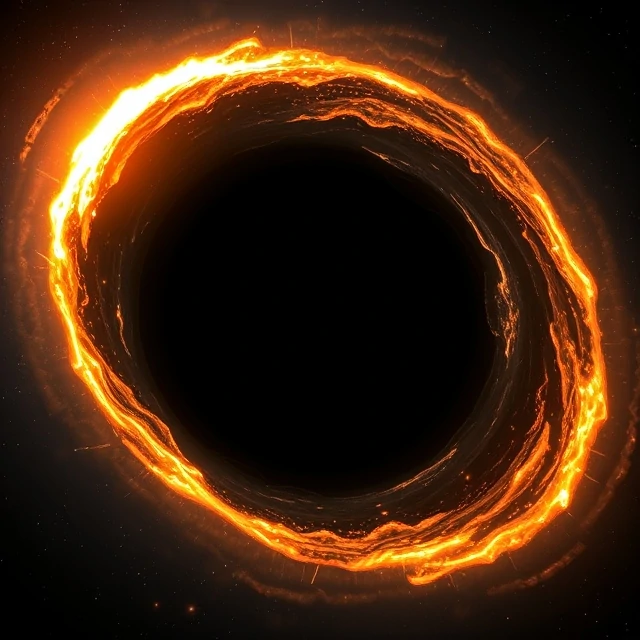
A black hole is a region of spacetime where gravity is so strong that nothing can escape, not even light. The boundary is called the event horizon. Cross it and there is no way back. The center holds a singularity, a point of infinite density where the known laws of physics break down. Black holes form when massive stars collapse at the end of their lives. The core implodes, and if enough mass remains, nothing can stop the collapse.
Black holes are not cosmic vacuum cleaners. They do not suck in everything nearby. An object orbiting at a safe distance stays in orbit, just as planets orbit the sun. The danger is only close to the event horizon. Astronomers detect black holes by their effects on nearby matter. Gas and dust heat up as they spiral inward, emitting X-rays. Gravitational waves ripple out when black holes merge. The first image of a black hole, released in 2019, showed the glowing ring around the event horizon of M87*, a supermassive black hole in a distant galaxy.
Black hole facts
- Event horizon. The point of no return.
- Singularity. The center, where density is infinite.
- Formation. Collapse of massive stars.
- Detection. X-rays from infalling matter, gravitational waves.
- Supermassive. Millions to billions of solar masses, at galaxy centers.
Time slows near a black hole. An astronaut hovering close to the event horizon would age more slowly than a distant observer.
Comments
No comments yet. Be the first to share a thought.
Leave a comment