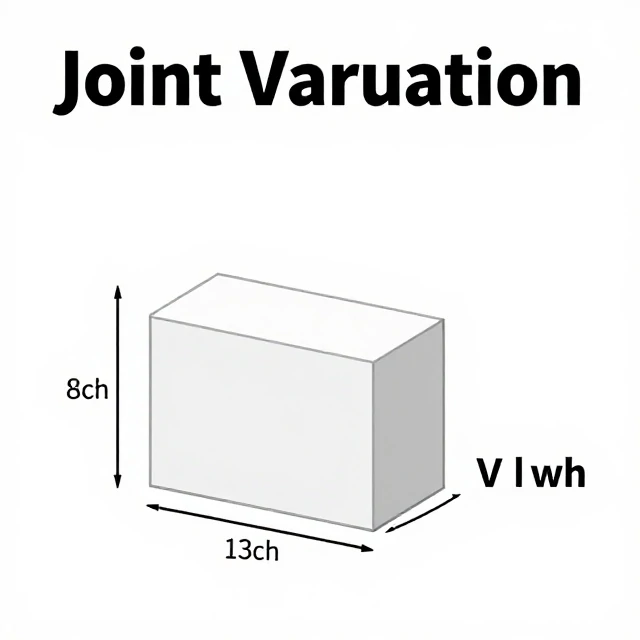
Joint variation describes a relationship where a variable varies directly with the product of two or more other variables. If z varies jointly with x and y, then z equals k times x times y, where k is a constant. Double x and z doubles. Double y and z doubles. Double both and z quadruples.
The volume of a rectangular prism varies jointly with its length, width, and height. V = lwh. The constant k is 1. The area of a triangle varies jointly with its base and height. A = 1/2 bh. The constant is 1/2. The force of gravity varies jointly with the masses of two objects and inversely with the square of the distance between them. That is Newton's law of universal gravitation.
Joint variation examples
- Volume of a prism: V = lwh.
- Area of a triangle: A = 1/2 bh.
- Gravitational force: F = G m1 m2 / r^2.
- Electrical power: P = VI.
- Ideal gas law: PV = nRT.
Joint variation combines direct variation with multiple variables. If z varies jointly with x and y, and x is constant, z varies directly with y. If y is constant, z varies directly with x. The constant k adjusts the relationship to the specific situation. In physics, the constants are often fundamental. G is the gravitational constant. R is the ideal gas constant. In business, the constant might be a conversion factor or a efficiency rate. Joint variation is a powerful modeling tool. It captures how multiple factors combine to produce an outcome. The more factors, the more complex the relationship. But the structure is simple: z equals k times the product of the variables. That simplicity makes joint variation useful in science, engineering, and economics.
Comments
No comments yet. Be the first to share a thought.
Leave a comment