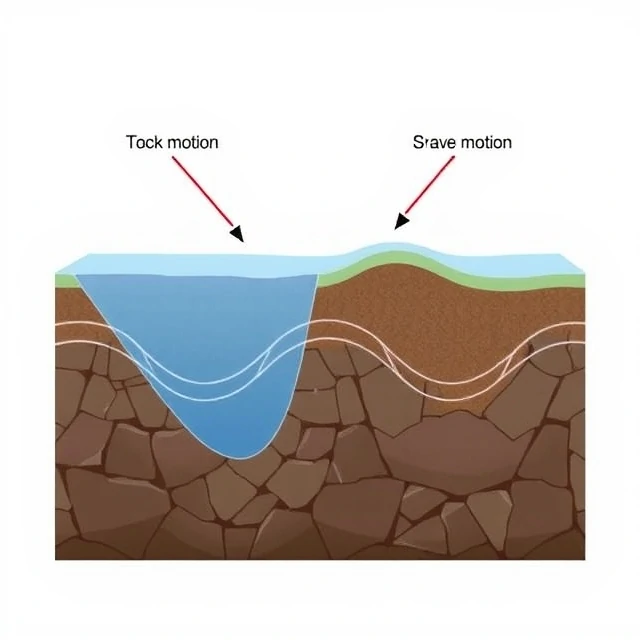
Energy released by an earthquake travels through the Earth as seismic waves. These elastic waves include body waves that pass through the interior and surface waves that travel along the ground surface. P-waves are compressional and fastest; S-waves are shear waves that follow them.
Surface waves generally cause the strongest shaking and most damage. Wave speeds depend on the elastic properties and density of the rocks they traverse. Refraction and reflection at boundaries allow seismologists to image Earth’s internal structure, including the crust, mantle, and core.
Recording seismic waves with networks of seismographs yields the location, magnitude, and mechanism of earthquakes. The same waves generated by controlled sources are used in exploration geophysics to map subsurface geology. Seismic waves remain the primary tool for probing the deep interior of the planet.
- Elastic wave generated by earthquakes or explosions
- Includes P-waves, S-waves, and surface waves
- Used to locate quakes and image Earth’s interior
- Speed depends on rock properties
Comments
No comments yet. Be the first to share a thought.
Leave a comment