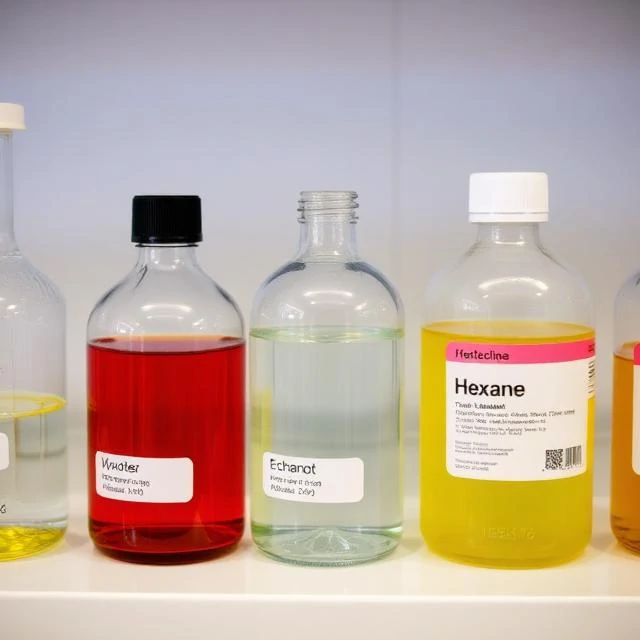
Water is the most common solvent. It dissolves more substances than any other liquid, which is why it is called the universal solvent. A solvent is the substance in which a solute is dissolved to form a solution. It is usually the component present in the larger amount. In saltwater, water is the solvent. In ethanol-water mixtures, the component present in the larger amount is the solvent. The distinction can be arbitrary when the amounts are similar.
Solvents are classified as polar or nonpolar. Polar solvents, like water, ethanol, and acetone, have partial charges that allow them to dissolve ionic and polar solutes. Nonpolar solvents, like hexane, benzene, and chloroform, dissolve nonpolar solutes. The rule like dissolves like applies. The choice of solvent determines what can be dissolved and how the solution behaves.
Solvents are used in many industries. They dissolve reactants for chemical synthesis. They extract compounds from natural products. They clean surfaces, dissolve paints, and dilute formulations. They are used in pharmaceuticals, cosmetics, printing, and manufacturing. Some solvents are hazardous. Organic solvents like benzene and carbon tetrachloride are toxic and carcinogenic. Green chemistry aims to replace them with safer alternatives.
Water is the greenest solvent. It is nontoxic, abundant, and cheap. But it does not dissolve everything. Sometimes a nonpolar solvent is necessary. The challenge is to choose the right solvent for the job while minimizing environmental and health impacts.
Comments (2)
Leave a comment