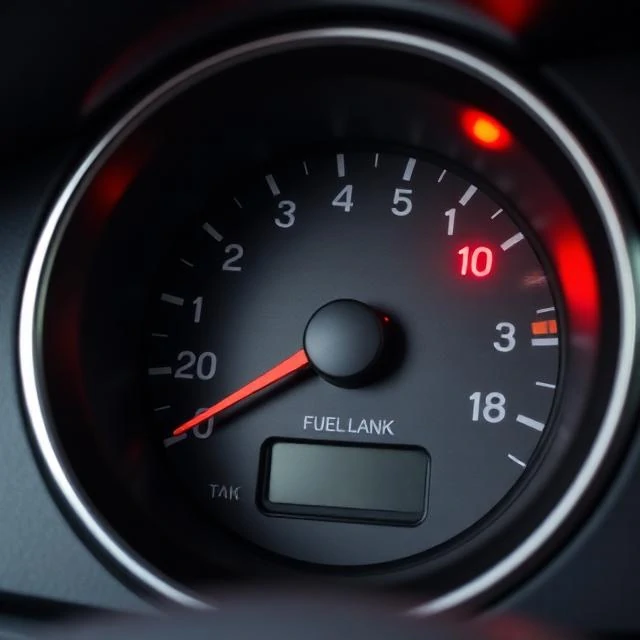
The fuel gauge tells you how much fuel is left in the tank. It sits on the dashboard, usually next to the speedometer. Most gauges have a needle that moves from full to empty, with a warning light that comes on when the tank is low. Some cars have digital gauges that show a range estimate in miles or kilometers.
The gauge works with a sending unit in the fuel tank. The sending unit has a float connected to a variable resistor. As the fuel level changes, the float moves, changing the resistance. That signal goes to the gauge, which displays the level. It is a simple system, but it can be inaccurate. The gauge may read full for a long time, then drop quickly. That is because the tank's shape is irregular and the float does not move linearly.
Modern cars calculate range using the fuel level and the average fuel economy. The range estimate can be misleading. It changes with driving conditions. If you drive uphill or accelerate hard, the range drops faster. If you coast downhill, it may increase. Do not rely on it to squeeze out the last few miles.
Running out of fuel is more than an inconvenience. In a diesel car, it can require bleeding the fuel system. In a gasoline car with an electric fuel pump, running dry can overheat and damage the pump. Fill up when the gauge reaches a quarter tank.
Comments (3)
Leave a comment