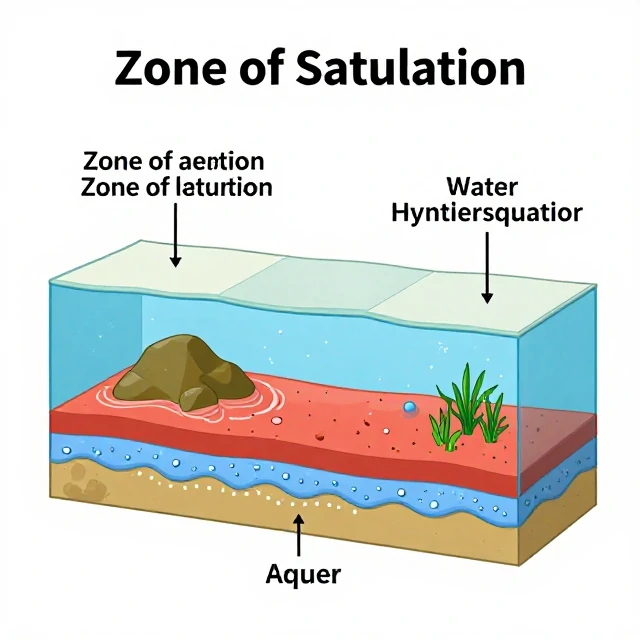
The zone of saturation is the underground layer where all pore spaces are filled with water. It is below the water table. Above it is the zone of aeration, where pores contain air and some water. The boundary between them is the water table. The water table rises and falls with rainfall and drought.
Groundwater fills the zone of saturation. It moves slowly through pores and fractures. The rate depends on the material. Sand and gravel transmit water quickly. Clay transmits it slowly. The zone of saturation is the source of wells. A well pumps water from the saturated zone. If the pump rate exceeds the recharge rate, the water table drops. The well runs dry.
Zone of saturation concepts
- Water table: the top of the saturated zone.
- Recharge: water entering the saturated zone.
- Discharge: water leaving the saturated zone.
- Aquifer: a permeable layer that holds water.
- Aquitard: a low-permeability layer that restricts flow.
The zone of saturation is critical for water supply. Half of the world's population relies on groundwater. In some regions, groundwater is being depleted faster than it is recharged. The Ogallala Aquifer in the United States is a famous example. It supports agriculture across eight states. But it is being pumped dry. The water table is dropping. Wells are failing. The zone of saturation is shrinking. That is a problem. Groundwater is a renewable resource, but only if recharge keeps up with discharge. In many places, it does not. The zone of saturation is invisible. It is underground. But it is essential. It is the water we drink. It is the water we irrigate with. It is the water that sustains life.
Comments
No comments yet. Be the first to share a thought.
Leave a comment