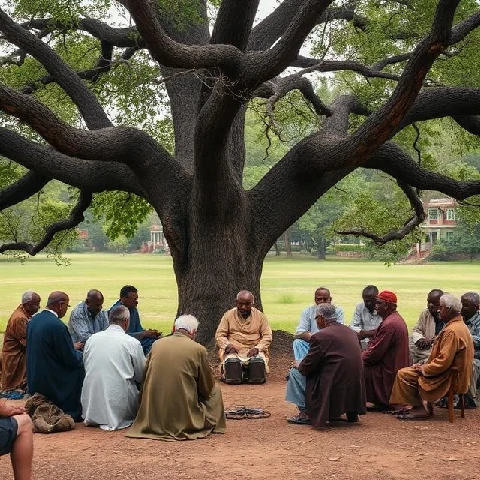
A tribe is a social group larger than a band, often linked by kinship and territory. The term has a complicated history. Early anthropologists used it to describe societies at a certain stage of evolution, between band and state. That framework is gone, but the word persists. Today it usually refers to a group with shared ancestry, language, or territory that recognizes some form of collective identity, often through councils or chiefs.
Tribes are not uniform. Some are egalitarian, others have ranked lineages. Some are fully independent, others exist within states. The term is often contested. In colonial contexts, administrators used tribe to divide and rule, assigning identities that had not existed before. In the Middle East and Africa, tribal affiliation remains politically salient, sometimes in ways that colonial maps helped create.
Common features
- Kinship as a primary organizing principle.
- Shared territory or ancestral homeland.
- Councils or chiefs with limited authority.
- Segmentary organization: groups split and reunite.
Tribe is a useful word only if used carefully. It describes a range of societies, not a single type.
Comments
No comments yet. Be the first to share a thought.
Leave a comment