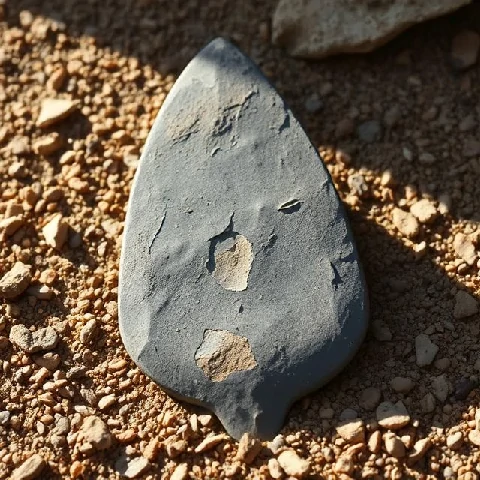
Acheulean tools fit the hand like they were made to be held. That is no accident. The signature artifact of this stone tool industry is the hand axe, a teardrop-shaped piece of flint or quartzite worked on both faces to a sharp edge. Some are small enough to tuck into a palm; others stretch nearly a foot long. The symmetry is striking, and it took real skill to achieve.
The industry emerged in Africa around 1.7 million years ago and spread across Europe and Asia with Homo erectus and later species. It lasted an extraordinarily long time, over a million years in some regions, which makes it one of the most persistent technological traditions in human history. Acheulean toolmakers chose particular stone sources, carried raw material over long distances, and reworked tools as they dulled.
What the tools tell us
- Bifacial working required planning and a mental template.
- Hand axes may have served as cutting, chopping, and digging tools.
- Some scholars argue they also functioned as social or mating signals.
- Distribution tracks the movement of early humans out of Africa.
Whether a hand axe was a practical butchering tool or a display of competence, each one preserves a decision made by a hominin hand long before writing existed.
Comments
No comments yet. Be the first to share a thought.
Leave a comment