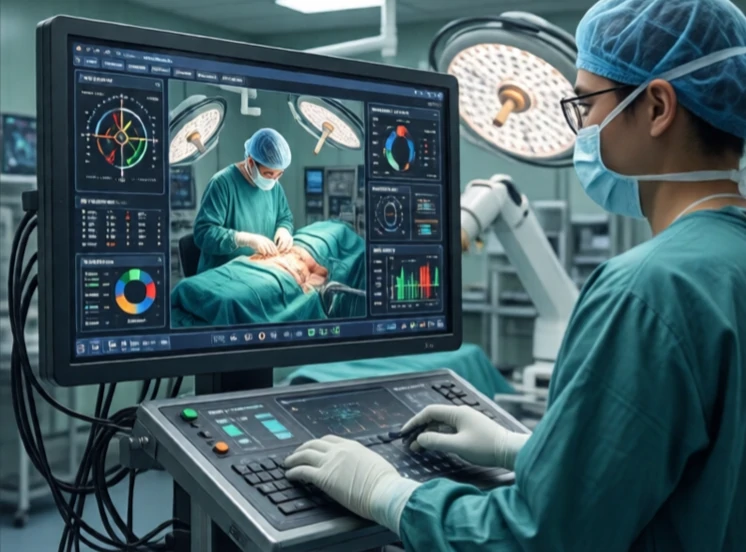
Teleoperation controls a robot remotely by a human operator. The operator sees what the robot sees and commands what the robot does. It is used when the task is too dangerous, too distant, or too precise for direct human presence. Bomb disposal, deep-sea exploration, and space missions all rely on teleoperation.
The simplest teleoperation is a joystick and a video feed. The operator drives the robot. More advanced systems use haptic feedback, where the operator feels what the robot touches. A surgeon using a da Vinci robot feels tissue resistance. A bomb technician feels the weight of an object. Haptic feedback closes the loop and makes teleoperation more intuitive.
Teleoperation challenges
- Latency: delay between command and response.
- Bandwidth: video and sensor data require high throughput.
- Situational awareness: operator sees only what cameras show.
- Control: mapping human inputs to robot motions.
- Safety: robot must fail safe if communication drops.
Latency is the enemy. On Earth, latency is milliseconds. On the Moon, it is seconds. On Mars, it is minutes. A rover on Mars cannot be driven in real time. The operator sends commands and waits. That is why Mars rovers are semi-autonomous. They execute commands and avoid obstacles on their own. Teleoperation works best when latency is low. For underwater ROVs, a tether provides low latency. For drones, radio links provide low latency within line of sight. For surgical robots, the surgeon is in the same room. Teleoperation extends human reach without sacrificing human judgment. It is not full autonomy. It is a partnership.
Comments (2)
Leave a comment