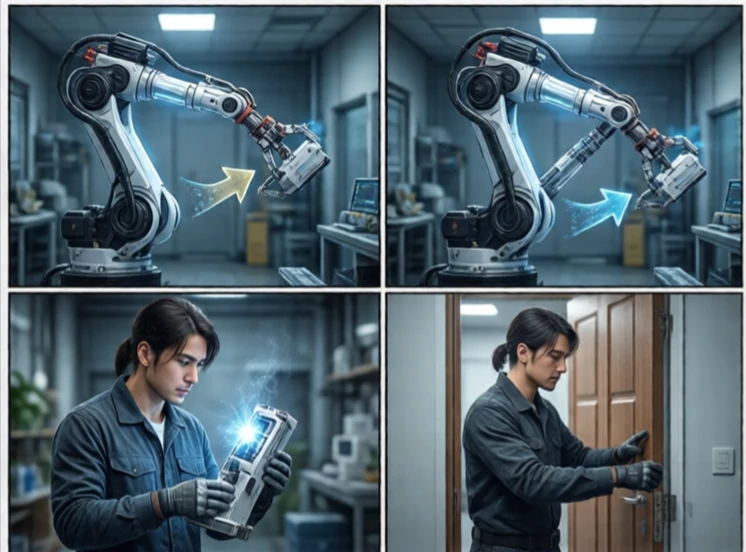
Task planning determines the sequence of actions to achieve a goal. It is higher-level than motion planning. Motion planning asks how to move. Task planning asks what to do. A robot might need to pick up a box, place it on a shelf, and close the door. Task planning orders those steps and handles dependencies.
The classic approach uses symbolic planning. The world is represented as states and actions. Each action has preconditions and effects. A planner searches for a sequence of actions that reaches the goal. PDDL, the Planning Domain Definition Language, is a standard for describing these problems. Modern planners use heuristics to search large state spaces efficiently.
Task planning challenges
- Combinatorial explosion: many possible action sequences.
- Uncertainty: actions may fail.
- Continuous state: real-world variables are not discrete.
- Human interaction: plans must be understandable.
- Integration: task planning must connect to motion planning.
Task planning is hard because the real world is messy. A symbolic planner assumes actions always succeed. A real robot might fail to grasp an object or find a door locked. That is why task planning often runs in a loop with execution and monitoring. The robot plans, acts, observes the result, and replans if needed. Some systems use hierarchical planning, breaking a task into subtasks and planning each. Others use behavior trees, which are easier to design and debug. Task planning is the bridge between a goal and the actions that achieve it. Without it, the robot has motion but no purpose.
Comments
No comments yet. Be the first to share a thought.
Leave a comment