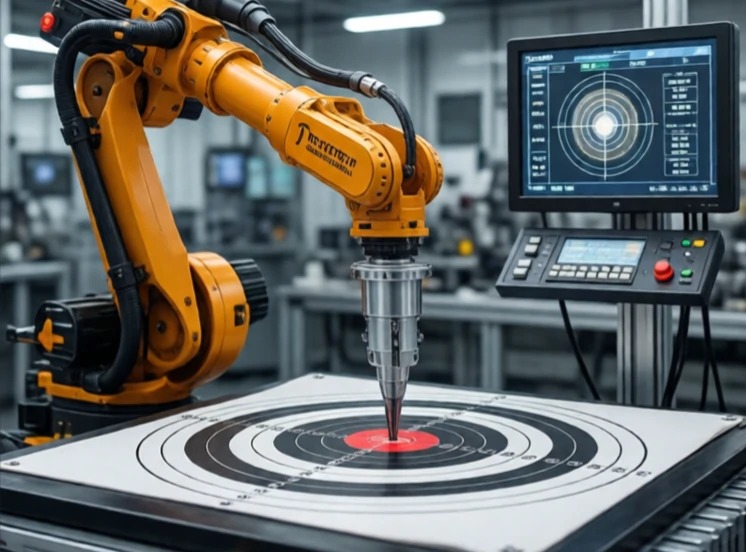
Integral control eliminates steady-state error. It sums the error over time and adds a correction that grows until the error disappears. If a robot arm stops slightly below its target, integral action keeps pushing until it reaches the exact position.
Proportional control alone often leaves a small offset. The controller output is proportional to the error, so a small error produces a small correction. If friction or gravity needs a constant torque, the system settles at a point where the proportional term provides just enough output. That point is not the setpoint. Integral control fixes this by accumulating the error and increasing output until the error is zero.
Integral control characteristics
- Eliminates steady-state error.
- Introduces a phase lag that can cause oscillation.
- Windup occurs when the actuator saturates.
- Anti-windup limits the integral term.
- Reset time determines how fast it acts.
The downside is overshoot and instability. The integral term keeps adding correction even after the error changes sign, which pushes the system past the target. Engineers add anti-windup to clamp the integral term when the actuator cannot keep up. They also tune the integral gain carefully. Too high and the system oscillates. Too low and it takes forever to eliminate the error. In a PID controller, integral action is the patient one. It waits, accumulates, and eventually gets the job done exactly.
Comments (2)
Leave a comment