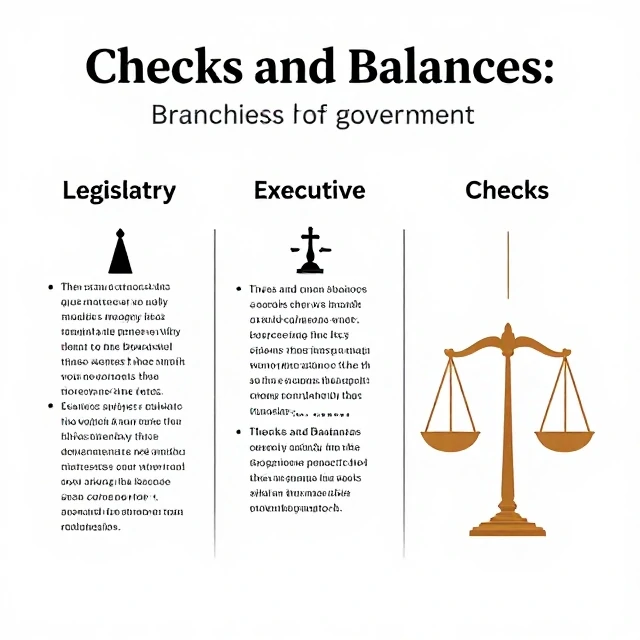
Checks and balances is a system that allows each branch of government to limit the powers of the others. The legislative branch makes laws. The executive branch enforces them. The judicial branch interprets them. Each branch can check the others. No branch is supreme. The system prevents tyranny. It requires compromise.
The framers of the US Constitution designed the system. They feared concentrated power. They divided it. Congress can pass a law. The president can veto it. Congress can override the veto with a two-thirds vote. The president can make treaties. The Senate must ratify them. The president can appoint judges. The Senate must confirm them. The courts can declare laws unconstitutional. The president can pardon. Congress can impeach. The checks are many.
Examples of checks and balances
- President vetoes legislation.
- Congress overrides a veto.
- Senate confirms or rejects appointments.
- Supreme Court declares a law unconstitutional.
- Congress impeaches and removes officials.
Checks and balances are not always smooth. They can cause gridlock. A divided government can struggle to pass laws. That is by design. The system favors deliberation over speed. It favors consensus over unilateral action. The framers wanted it that way. They had seen the abuse of power. They wanted to prevent it. Checks and balances are not perfect. They can be gamed. They can be ignored. They depend on norms and good faith. But they remain a cornerstone of the Constitution. They are the machinery of limited government. They are the answer to the question: who watches the watchmen? The branches watch each other.
Comments
No comments yet. Be the first to share a thought.
Leave a comment