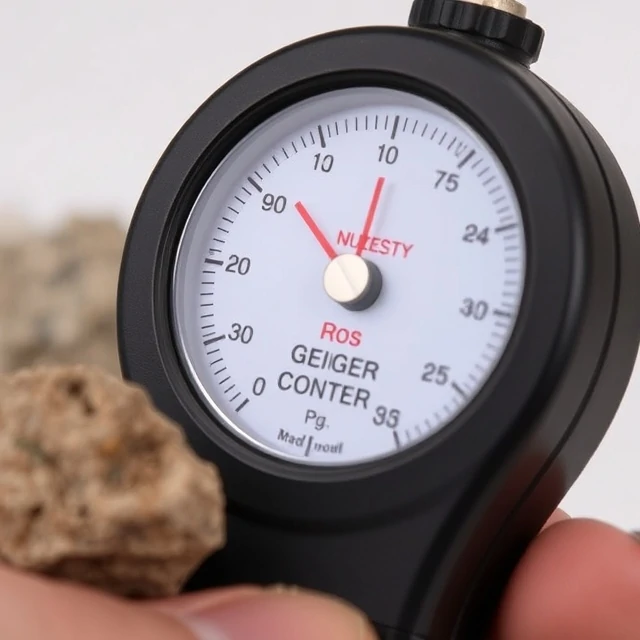
Some atomic nuclei are unstable. They decay over time, emitting particles or energy. That process is radioactivity. It was discovered by Henri Becquerel in 1896, and studied by Marie and Pierre Curie. Radioactivity comes in three main types: alpha decay, beta decay, and gamma decay. Alpha decay emits a helium nucleus. Beta decay emits an electron or positron. Gamma decay emits a high-energy photon. Each type has different penetrating power. Alpha particles can be stopped by a sheet of paper. Beta particles can be stopped by a few millimeters of aluminum. Gamma rays require thick lead or concrete.
Radioactivity is measured in becquerels, which count decays per second. The half-life of a radioactive isotope is the time it takes for half of the atoms to decay. Half-lives range from fractions of a second to billions of years. Uranium-238 has a half-life of 4.5 billion years. Carbon-14 has a half-life of 5,730 years. That makes it useful for dating archaeological artifacts. Radioactivity has many uses. It powers nuclear reactors. It is used in medical imaging and cancer treatment. It is used in smoke detectors and in sterilizing medical equipment. But it also poses risks. Radiation can damage cells and cause cancer. Radioactive waste remains dangerous for thousands of years. Managing that waste is one of the challenges of nuclear power.
Radioactivity facts
- Definition. Emission of particles or energy from unstable nuclei.
- Types. Alpha, beta, gamma.
- Half-life. Time for half the atoms to decay.
- Unit. Becquerel (Bq).
- Uses. Power, medicine, dating, smoke detectors.
Radioactivity is not the same as radiation. Radioactivity is the process. Radiation is the energy emitted.
Comments
No comments yet. Be the first to share a thought.
Leave a comment