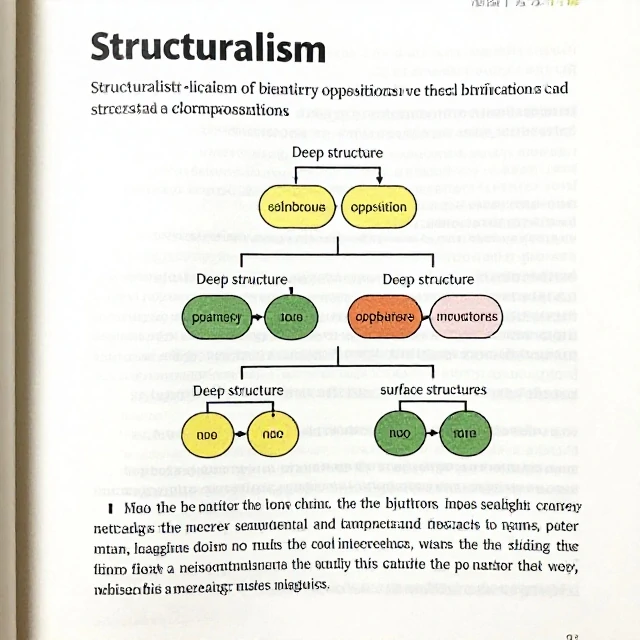
Structuralism is a method of analysis that focuses on underlying structures. It looks for the deep patterns that shape surface phenomena. In linguistics, it looks for the rules of language. In anthropology, it looks for the structures of myth and kinship. In literature, it looks for the structures of narrative. The surface varies. The structure is constant.
The movement emerged in France in the 1950s and 1960s. Claude Levi-Strauss applied structuralism to anthropology. Roland Barthes applied it to literature. Ferdinand de Saussure provided the linguistic foundation. They argued that meaning comes from difference. A word means what it means because it is not other words. The structure is a system of differences.
Structuralist concepts
- Langue and parole: the system and its use.
- Signifier and signified: the word and the concept.
- Binary oppositions: pairs of terms that structure meaning.
- Deep structure: the underlying rules.
- Surface structure: the observable phenomena.
Structuralism was influential. It offered a scientific approach to culture. It looked for universal patterns. It challenged the idea that meaning is subjective. It argued that meaning is systematic. But structuralism was criticized. Post-structuralists said it was too static. It ignored history. It ignored power. It assumed a stable structure that does not exist. Structuralism declined in the 1970s. But its influence remains. It taught us to look for deep patterns. It taught us that meaning is relational. It taught us that the surface is not the whole story. Structuralism is a method. It is not the only method. But it is a powerful one. It looks beneath the surface. It finds the structure. That is its contribution.
Comments
No comments yet. Be the first to share a thought.
Leave a comment